
Crypto Developer: The Trump Family's Coin Minting Real Estate Business




Original Article Title: "Trump's Son's Crypto Business Acumen"
Original Article Author: Bright, Foresight News
During Token2049 Dubai, the Trump family made another move.
On the evening of April 29, as reported by The National, Eric Trump, Executive Vice President of The Trump Organization, revealed that The Trump Organization will partner with the London-listed company Dar Global to launch a $1 billion development project in Dubai, including a Trump-branded hotel, residential units, and a club. The tower will be located at the entrance of Sheikh Zayed Road in downtown Dubai and is expected to be completed within five years. This project will accept cryptocurrency payments. While this is not the first real estate venture of the Trump family in the Middle East, it is the first building where Eric Trump, the Trump family's second son, has explicitly stated a tie to cryptocurrency.
On April 30, according to The Block, Trump Media & Technology Group plans to launch the Truth Social utility token. The token will be integrated into the Truth digital wallet, initially used to pay for Truth+ subscription fees, and could expand to cover other products and services within the Truth Social ecosystem in the future.
The Trump family, which has tasted the sweet fruits of political influence in the crypto space, continues to expand its crypto footprint. Eric Trump, in particular, has emerged as the crypto "vanguard" within the Trump family.
A Crypto Career with Smooth Sailing
In 2006, Eric Trump graduated from Georgetown University with a Bachelor's degree in Finance and Management. That same year, he joined The Trump Organization as Executive Vice President of Development and Acquisitions. In 2012, Forbes named Eric Trump one of the "30 Under 30" in real estate. When Trump assumed the U.S. presidency for the first time in 2017, he retained ownership of The Trump Organization but handed control of this vast business empire to his eldest son, Donald Jr., and second son, Eric. Without any dramatic or sensational twists, Eric Trump has always diligently worked for the Trump family. And now, as the Executive Vice President of The Trump Organization, Eric Trump continues to prominently represent the Trump family's foray into crypto.
From the 2024 Abu Dhabi Bitcoin MENA to the 2025 Token2049 Dubai, in less than a year, Eric Trump has accumulated titles from various crypto companies. Not only has he served as an ambassador in the directly affiliated World Liberty Financial and as Chief Strategic Officer in the new Bitcoin mining company American Bitcoin, but he has also been hired as an advisor by well-known crypto companies like Japan's "MicroStrategy" Metaplanet.

In fact, serving as an advisor to become a crypto giant is just a commonplace matter for Eric Trump, who is backed by the Trump family. With the halo of "my dad is the president," Eric Trump can easily chat with Michael Saylor at the Mar-a-Lago estate. What truly attracts attention from the outside world is Eric Trump's "extremely close" attitude towards crypto.
Eric Trump once said in an interview with CNBC, "You will find that cryptocurrency is faster, more practical, more transparent, and much lower in cost." Unlike Donald Trump sitting on the presidential throne, the less restricted Eric Trump is seen as a "glove puppet" directly implementing the Trump business will. He has repeatedly expressed his bullishness on crypto in social media and public speeches, stating that "Bitcoin is one of the greatest stores of value" and "now is a good time to bet on cryptocurrency."
"Now, I know almost everyone in this industry more or less," Eric Trump said. "A few years ago, I fell in love with this industry and then dived into it headfirst."
The "Two-Way Rush" of Interests
However, Eric Trump, coming from a business family, has inherited a speculative style. Behind his "enthusiastic bullishness," perhaps there is more of the Trump family's further money-grabbing plan.
In the traditional financial field, the influence of the U.S. President is still subject to a relatively complete legal system and financial institutional balance, and the intricate Wall Street power also exerts considerable influence on the White House. In 2022, about two years after the end of Trump's first term as president, two subsidiaries of the Trump Group were convicted by a New York jury on numerous charges, including tax fraud, falsifying business records, and conspiracy. All 17 charges were found guilty three weeks after Trump announced his candidacy for the 2024 election. Meanwhile, a Florida bank named Capital One closed over 300 Trump Group bank accounts immediately after the January 6, 2021, U.S. Capitol riot.
Therefore, before Trump returns to the White House, the Trump Group announced a new ethical plan, stating that it will restrict Trump's involvement in management decisions and other business aspects during his presidential term. Eric Trump publicly stated that the Trump Group is "perhaps the most restricted company on earth."
In contrast, the cryptocurrency field, which operates on the regulatory edge and has abundant liquidity, has become a favorite of the Trump family. Just the Trump and Melania meme coins alone have added billions of dollars to the family's balance sheet wealth. The Trump family has given up skimming oil directly from the intricate Wall Street power and instead entered the crypto field in the guise of protecting financial innovation and crypto liberators. Eric Trump openly stated that his entry into the cryptocurrency field was not a financial gamble but a form of resistance. This move began with what he called a "war on the industry." He declared that banks are closing accounts, the U.S. Securities and Exchange Commission is cracking down on trading platforms, and cryptocurrency users are being "deprived of bank accounts" simply for holding cryptocurrency.
However, during the second term of President Trump, who held significant power, the U.S. cryptocurrency field did indeed continue to break free from constraints. The U.S. Securities and Exchange Commission (SEC) and the Commodity Futures Trading Commission (CFTC) were previously very strict in their scrutiny of cryptocurrency trading platforms and projects. However, since Trump took office, the U.S. has taken a big step forward in cryptocurrency regulation, successively abolishing the "Defi Broker Rule," dropping the lawsuit against XRP, and releasing the Silk Road founder, among other actions.
It can be said that in the U.S. political world where power and money are intertwined, the Trump family, with a sharp businessman's eye, chose the easiest path to riches.

The Legendary Reverse "Pump-and-Dump King"
However, Eric Trump's three high-profile calls in 2025 had an eerie cause-and-effect relationship with the market's significant downturn:
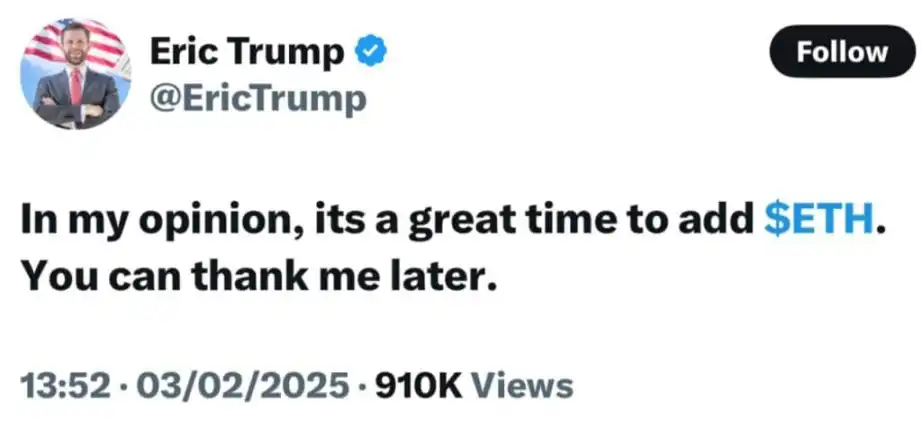
On February 3, Eric posted on X platform, stating, "In my opinion, now is a good time to accumulate $ETH. You can thank me later." At that time, the Ethereum price was hovering around $2,900, and the market sentiment was somewhat optimistic due to the Trump family's World Liberty Financial (WLFI) project. However, within 48 hours of the call, the ETH price plummeted to $2,000, a drop of over 30%. On-chain data showed that WLFI transferred around $300 million worth of crypto assets to Coinbase Prime on the day of the call, including 66,000 ETH.
Then, on February 25, when the Bitcoin price was approaching $89,000, Eric once again spoke up, advising investors to "buy BTC on dips, as long-term holding is the way to go." The result was that the next day, the Bitcoin price sharply dropped to $78,258, a one-day decline of 12%. Lookonchain's analysis showed that WLFI sold around 12,000 BTC (approximately $1 billion) before and after the call, aligning closely with the market's selling pressure peak.
On March 2, after the Trump administration announced the exploration of cryptocurrency assets as a possible national reserve, Eric quickly followed up, calling for "long-term holding of cryptocurrency, as the future is decentralized." Even tweets on the Trump X account announcing the national reserve had an undeniable connection to Eric. However, the next day, Ethereum surged before crashing again by 17.5%, with the decline widening to 30% within a week, reaching a low of $1,410. On-chain analysts found that WLFI sold a total of 86,000 ETH (about $235 million) during this period, with a significant price difference between their cost basis ($3,354) and the market price ($1,550), once again exposing their awkward position of "buying high and selling low." On the X platform, the topic of NeverTrustEric surpassed even #Bitcoin in popularity, with community members spontaneously compiling the "Eric Pump-and-Dump Index" as a market risk warning signal.
At one point, WLFI became the market's scapegoat, with the selloff resulting in a book loss of over a billion dollars, raising questions about off-exchange profit-taking through derivatives hedging. WLFI's business model was once again criticized—WLFI had raised $550 million through the issuance of governance tokens, but token holders only had voting rights and no dividend rights, with the official website explicitly stating that "the purchase of tokens should not be for profit-seeking purposes." "This is fundamentally a capital game that does not require accountability to investors," commented cryptocurrency compliance firm Chainalysis, stating that "political dynasties are leveraging regulatory gray areas to transform social media influence into financial harvesting tools."
However, this did not affect the ongoing construction of the Dubai Trump Tower. Eric Trump is aware that the crypto world needs the Trump family's political influence, and he will continue to promote it.
You may also like

Japan’s Three Megabanks Plan Joint Stablecoin Issuance in Fiscal 2026
MUFG, SMBC, and Mizuho reportedly plan to jointly issue fiat-pegged stablecoins in fiscal 2026, signaling Japan’s growing push into bank-led digital payment infrastructure.

Humanity Discloses H Token Dual-Chain Attack Details, With Losses on Ethereum and BSC Exceeding $36 Million
Humanity said the H token attack across Ethereum and BSC caused more than $36 million in losses after leaked ProxyAdmin keys enabled malicious contract upgrades and token minting.

White House Discusses CLARITY Act With Law Enforcement Ahead of Senate Vote
The White House discussed the CLARITY Act with law enforcement ahead of a Senate vote, focusing on illicit finance risks and developer protections.

$75 billion in foreign capital has fled, and South Korean retail investors have absorbed it all using leverage

Bitcoin Trading Guide 2026: Strategies for Experienced Traders

What Is XAUT and PAXG? Why Tokenized Gold Is Booming in 2026

Cryptocurrency CEXs are flocking to sell US stocks, and traditional brokerages are facing an "uninvited guest."

Will the SpaceX IPO Hurt Bitcoin? Here's What Traders Are Watching
Foreign selling in the South Korean stock market accelerates, with cumulative net sales reportedly reaching $75 billion this year
On June 9, The Kobeissi Letter, citing Goldman Sachs data, reported that global investors are selling South Korean stocks at an unusually rapid pace. In the latest trading session, foreign investors sold about $801 million worth of Kospi constituent stocks again; total foreign outflows last week reached about $10 billion, and the market has been in net foreign selling on nearly every trading day over the past month. According to the data cited in the report, foreign investors have sold about $75 billion worth of South Korean stocks so far this year. Meanwhile, South Korean retail and institutional investors together recorded roughly $69 billion in net buying over the same period, suggesting that the market’s main buying support has come from domestic capital rather than returning overseas funds. The information currently disclosed still mainly comes from The Kobeissi Letter’s retelling and Goldman Sachs data summaries, while public details on the statistical period and the specific definition of “selling” remain relatively limited.

Fortune Warns of Strategy’s Financing Structure Risks as Bitcoin Premium Narrows
Fortune warned that Strategy’s Bitcoin treasury model faces growing financing risks as MSTR’s net asset premium narrows and preferred stock dividend pressure increases.

Ferrari Challenge Le Mans: Carl Moon to Dominate in WEEX Livery

Sahara AI Responds to SAHARA’s Sharp Drop: No Contract or Product Security Issues Found, Internal Investigation Underway
Sahara AI responded to SAHARA’s 60% price drop, saying no token contract or product security issues have been found and an internal investigation is underway.

WEEX Deposit/Withdrawal Dynamic Island: Your Asset Status, Always in Sight
Scaling Crypto Derivatives: The Digital Asset Infrastructure Behind High-Volume Trading
In the fast-moving digital asset ecosystem, derivatives platforms face an extreme architectural test. High-leverage futures markets demand more than just standard security—they require absolute operational precision, zero-latency matching engines, and ironclad structural scalability, all while navigating intense market volatility.
As global platforms scale to meet these demands, the industry is shifting away from rigid, monolithic setups toward a more agile, "decoupled" infrastructure philosophy.
The Blueprint for High-Volume Copy TradingFor elite global exchanges like WEEX (founded in 2018), this architectural choice becomes critical when scaling high-volume retail features like social copy trading. When thousands of users automatically mirror the real-time strategies of elite traders simultaneously, it triggers sudden, monumental spikes in concurrent transactional volume.
To prevent execution latency or settlement bottlenecks during these peak volatility events, a platform's primary engine must remain entirely dedicated to risk management, copy-trade synchronization, and order matching.
The Architectural Rule: New-generation platforms must separate front-end user execution engines from heavy backend infrastructural overhead to eliminate operational friction.
By separating these layers, platforms can maintain complete sovereignty over their trading environments and user experiences while strategically aligning with institutional-grade infrastructure ecosystems. This strategic framework allows modern exchanges to leverage advanced Digital Asset Custody infrastructure such as Cobo’s behind the scenes, ensuring that backend wallet management scales elastically alongside trading spikes.
Capitalizing on Market Momentum and 400× LeverageIn a derivatives arena where platforms offer up to 400× leverage on perpetual contracts, capital efficiency and market agility are core business metrics. To capture market momentum, an exchange needs the ability to rapidly expand its asset offerings, supporting everything from legacy crypto assets to sudden, trending altcoins across a massive library of trading pairs.
Adopting a flexible, scalable Wallet-as-a-Service (WaaS) solution such as Cobo’s could completely rewrite the development timeline for high-growth exchanges. Instead of spending months of engineering capital building out custom backend wallet architectures for every new blockchain network, platforms can deploy localized infrastructure in days.
This agility allows platforms to instantly scale their listings to over a thousand trading pairs without compromising security or delaying time-to-market. It mirrors the exact operational advantages seen during high-velocity market events, similar to how advanced wallet infrastructure empowers platforms during sudden asset surges; allowing exchanges to pass that speed and liquidity directly to their global user base.
A Mature Foundation for GrowthThe synergy between trusted infrastructure ecosystems and global trading platforms represents the natural evolution of a maturing crypto market. As WEEX continues to scale its global spot and derivatives offerings for over 6 million users, adopting robust backend paradigms proves that platforms no longer have to compromise between cutting-edge trading velocity and uncompromised structural security.

Morning Report | BitMine increased its holdings by 126,971 ETH last week; trader Eugene announced his exit from the crypto market

Wang Chuan: How can one not feel anxious after the neighbor Old Wang made thirty times profit by investing in storage stocks? (Seven) - A quarter-century cycle

Get Paid to Onboard? Try WEEX’s New Homepage with Rewards for Registration, Deposit & Trade
WEEX Custom Layout: Build Your Perfect Trading Workspace in Seconds
Japan’s Three Megabanks Plan Joint Stablecoin Issuance in Fiscal 2026
MUFG, SMBC, and Mizuho reportedly plan to jointly issue fiat-pegged stablecoins in fiscal 2026, signaling Japan’s growing push into bank-led digital payment infrastructure.
Humanity Discloses H Token Dual-Chain Attack Details, With Losses on Ethereum and BSC Exceeding $36 Million
Humanity said the H token attack across Ethereum and BSC caused more than $36 million in losses after leaked ProxyAdmin keys enabled malicious contract upgrades and token minting.
White House Discusses CLARITY Act With Law Enforcement Ahead of Senate Vote
The White House discussed the CLARITY Act with law enforcement ahead of a Senate vote, focusing on illicit finance risks and developer protections.
$75 billion in foreign capital has fled, and South Korean retail investors have absorbed it all using leverage
Bitcoin Trading Guide 2026: Strategies for Experienced Traders
What Is XAUT and PAXG? Why Tokenized Gold Is Booming in 2026


