
Delisting Without Price Drop? Unveiling the Capital 'Short-and-Distort' Play Behind ALPACA


Original Article Title: "From Delisting to Price Surge? Unveiling the Capital 'Raid Drama' Behind ALPACA"
Original Article Author: Fairy, ChainCatcher
From "Delisting Bomb" to "Wealth Rocket"?
On April 24, Binance announced the delisting of the ALPACA token. Normally, delisting news would result in selling pressure, panic, and a price crash. However, ALPACA defied expectations and has surged over 650% since the announcement.
This bizarre rebound begs the question: is it a last gasp of the project or a scripted move by capital players? Behind this sudden and dramatic surge, a storm may be brewing...
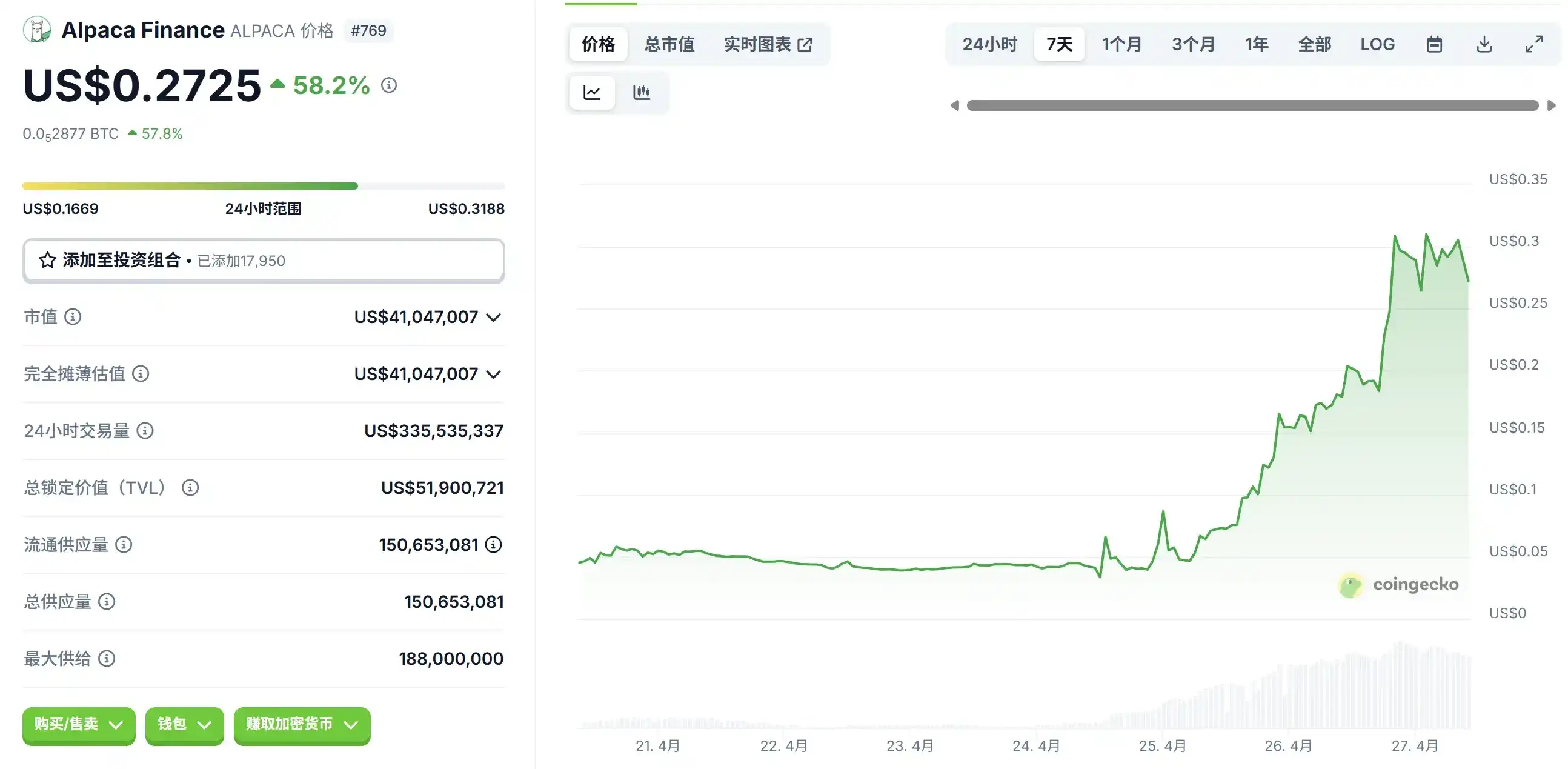
Image Source: Coingecko
From Delisting Countdown to "Sky Clearing" Moment
On April 10, Binance initiated the second phase of its coin delisting vote. A week later, the results were announced, with ALPACA ranking seventh out of 17 candidate projects, signaling the delisting crisis. On April 24, Binance officially announced the delisting of ALPACA on May 2 and the perpetual contract settlement on April 30. Following the news, ALPACA's price plummeted from $0.0329 to $0.029, with its market cap shrinking to $5 million.
Just when the market anticipated ALPACA's demise, a dramatic scene unfolded: within one hour, the price surged from $0.029 to $0.0857, a staggering 195% increase. This sudden and sharp surge caught the shorts off guard and set the stage for even crazier price action to come.
On April 25, Alpaca Finance's official announcement stated that due to a trading volume exceeding 1 billion tokens, a liquidity provider had requested a token minting to maintain liquidity, but this plan was canceled after community opposition. This change undoubtedly dealt another blow to the bears.
Consequently, on April 26, ALPACA's liquidation volume even surpassed that of Bitcoin, with short liquidations dominating. Throughout the entire market activity, it seemed to have turned into a "precision harvesting battle" against the shorts.
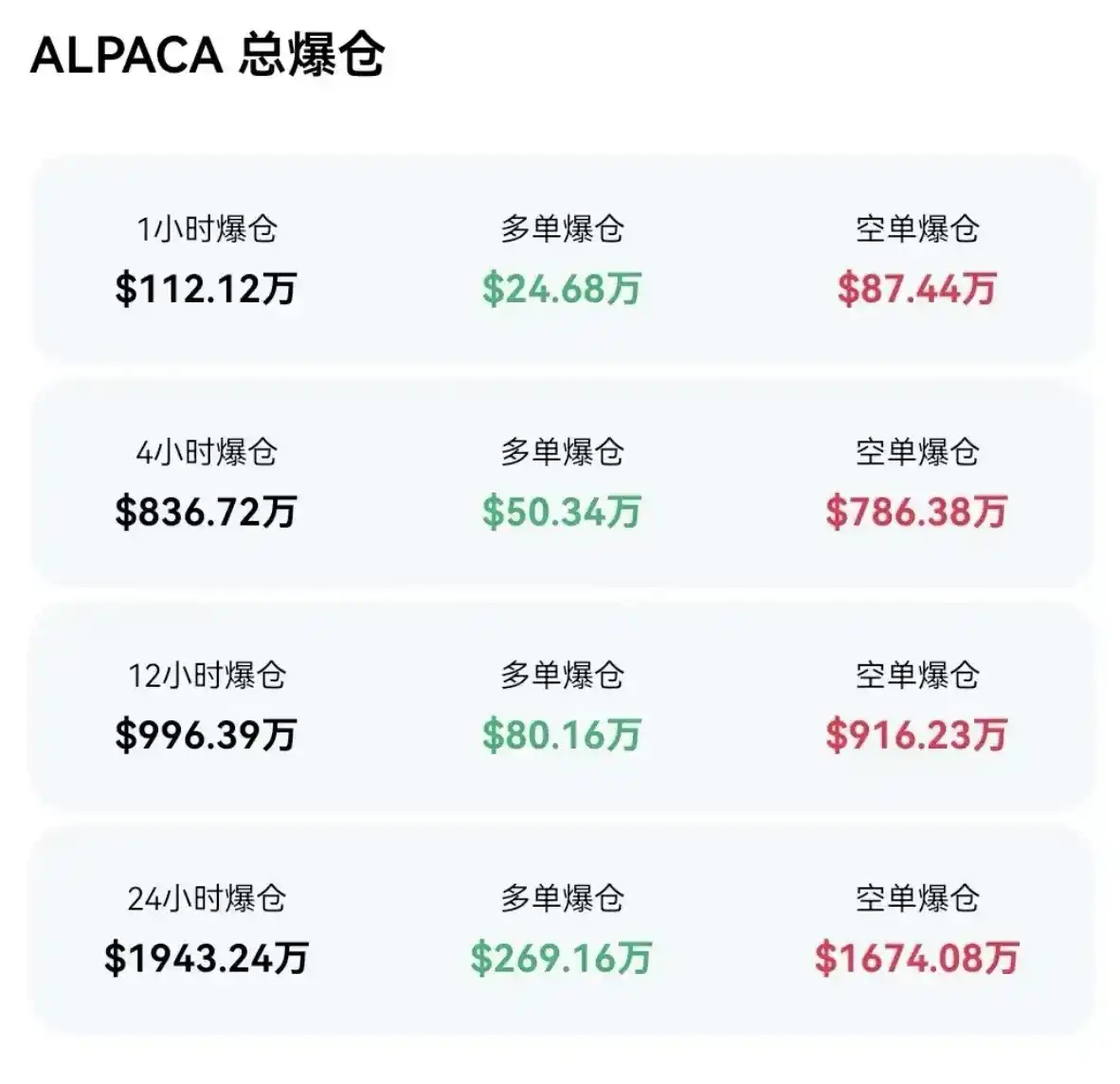
Image Source: Coinglass
「Short Squeeze Playbook」
Regarding the rebound of ALPACA, He Yi expressed that this may be a quick break-even maneuver by shell-buying investors through short-term manipulation. Based on the analysis of community users @LuBtc 888, @0x_ooorange, and @Mumu_yay, we have outlined a complete "Short Squeeze Playbook":
I. Advance Layout before Delisting
Prior to the delisting announcement, the "whales" may have early knowledge or sensed abnormalities. There was suspected capital absorption around April 19. During this period, the trading volume of ALPACA on Binance significantly increased, but the price increase was very limited.
II. Creating Expectation Misalignment, the Emergence of a "Bearish Trap"
The market generally expected "delisting = crash". Retail investors and short-term speculators collectively had a bearish view, leading to an influx of short positions and a surge in the open interest of ALPACA contracts. The "whales" took advantage of this situation to absorb funds at low levels, built long positions massively at the bottom, then raised the spot price sharply, triggering a chain of short liquidations.
III. Rule Changes Accelerate the Short Squeeze Pace
Binance shortened the funding rate collection period from 8 hours to 1 hour, causing the ALPACA funding rate to plummet to -2%. Shorts not only faced the risk of liquidation but also had to pay high "interest" every hour, forcing them to accelerate their liquidation, leading to an accelerated short squeeze, with the speed of the pump also rapidly increasing.
IV. The Main Player's Profit Model
· Spot Market: Absorb chips during the delisting panic, create a "last glory" illusion during the pump, attract retail investors to chase the price higher, then unload at a high.
· Futures Market: Hold a huge amount of long positions, continuously collect interest payments from shorts through the negative fee rate mechanism, achieving profits from both directions.
ALPACA Post-Event Suspense
Regarding the future trend of ALPACA, the market opinions are divided. @Mumu_yay believes that the delisting announcement will trigger the liquidation mechanism, meaning that the positions of both longs and shorts will be automatically cleared. In this case, the "whales" do not need to worry about finding exit liquidity; they just need to wait at a high level and prepare for liquidation to be triggered.
However, crypto KOL Kuang Ren Madman holds a different view. He believes that from a game theory perspective, whales will choose to gradually establish long positions at highs, then switch to short positions, use this to suppress the spot price, and ultimately maximize their interests through liquidation. Therefore, his conclusion is that the trend of ALPACA will lead to a crash.
Furthermore, trader @thankUcrypto pointed out that usually, a pump occurs before delisting, followed by a dump before delisting as well. As Binance is the platform with the strongest market liquidity, if it does not engage in a dump operation before delisting on May 2, market makers will have to wait until after delisting to dump on other trading platforms. However, due to the shallow order books and buy support on other platforms, the profit from dumping would be significantly reduced.

The Storm Is Not Over, the Future Is Uncertain
As the delisting date of May 2 approaches, ALPACA's fate remains uncertain. Its price trajectory has become a typical example of capital gamesmanship in the crypto market. The market is always cyclical, and perhaps in the future, new "ALPACAs" will continue to emerge, staging similar dramas in different forms.
In the midst of the storm, rationality remains the only reliable anchor for investors. Faced with short-term emotions and temptations, only by remaining clear-headed and keeping our eyes wide open can we avoid losing our way in the chaos. Stay away from high-risk coins lacking fundamental support and be vigilant of the hidden currents of manipulation and control. In navigating the seas, only a steady helmsman can steer clear of reefs.
You may also like

$75 billion in foreign capital has fled, and South Korean retail investors have absorbed it all using leverage

Bitcoin Trading Guide 2026: Strategies for Experienced Traders

What Is XAUT and PAXG? Why Tokenized Gold Is Booming in 2026

Cryptocurrency CEXs are flocking to sell US stocks, and traditional brokerages are facing an "uninvited guest."

Will the SpaceX IPO Hurt Bitcoin? Here's What Traders Are Watching
Foreign selling in the South Korean stock market accelerates, with cumulative net sales reportedly reaching $75 billion this year
On June 9, The Kobeissi Letter, citing Goldman Sachs data, reported that global investors are selling South Korean stocks at an unusually rapid pace. In the latest trading session, foreign investors sold about $801 million worth of Kospi constituent stocks again; total foreign outflows last week reached about $10 billion, and the market has been in net foreign selling on nearly every trading day over the past month. According to the data cited in the report, foreign investors have sold about $75 billion worth of South Korean stocks so far this year. Meanwhile, South Korean retail and institutional investors together recorded roughly $69 billion in net buying over the same period, suggesting that the market’s main buying support has come from domestic capital rather than returning overseas funds. The information currently disclosed still mainly comes from The Kobeissi Letter’s retelling and Goldman Sachs data summaries, while public details on the statistical period and the specific definition of “selling” remain relatively limited.

Fortune Warns of Strategy’s Financing Structure Risks as Bitcoin Premium Narrows
Fortune warned that Strategy’s Bitcoin treasury model faces growing financing risks as MSTR’s net asset premium narrows and preferred stock dividend pressure increases.

Ferrari Challenge Le Mans: Carl Moon to Dominate in WEEX Livery

Sahara AI Responds to SAHARA’s Sharp Drop: No Contract or Product Security Issues Found, Internal Investigation Underway
Sahara AI responded to SAHARA’s 60% price drop, saying no token contract or product security issues have been found and an internal investigation is underway.

WEEX Deposit/Withdrawal Dynamic Island: Your Asset Status, Always in Sight

Scaling Crypto Derivatives: The Digital Asset Infrastructure Behind High-Volume Trading
In the fast-moving digital asset ecosystem, derivatives platforms face an extreme architectural test. High-leverage futures markets demand more than just standard security—they require absolute operational precision, zero-latency matching engines, and ironclad structural scalability, all while navigating intense market volatility.
As global platforms scale to meet these demands, the industry is shifting away from rigid, monolithic setups toward a more agile, "decoupled" infrastructure philosophy.
The Blueprint for High-Volume Copy TradingFor elite global exchanges like WEEX (founded in 2018), this architectural choice becomes critical when scaling high-volume retail features like social copy trading. When thousands of users automatically mirror the real-time strategies of elite traders simultaneously, it triggers sudden, monumental spikes in concurrent transactional volume.
To prevent execution latency or settlement bottlenecks during these peak volatility events, a platform's primary engine must remain entirely dedicated to risk management, copy-trade synchronization, and order matching.
The Architectural Rule: New-generation platforms must separate front-end user execution engines from heavy backend infrastructural overhead to eliminate operational friction.
By separating these layers, platforms can maintain complete sovereignty over their trading environments and user experiences while strategically aligning with institutional-grade infrastructure ecosystems. This strategic framework allows modern exchanges to leverage advanced Digital Asset Custody infrastructure such as Cobo’s behind the scenes, ensuring that backend wallet management scales elastically alongside trading spikes.
Capitalizing on Market Momentum and 400× LeverageIn a derivatives arena where platforms offer up to 400× leverage on perpetual contracts, capital efficiency and market agility are core business metrics. To capture market momentum, an exchange needs the ability to rapidly expand its asset offerings, supporting everything from legacy crypto assets to sudden, trending altcoins across a massive library of trading pairs.
Adopting a flexible, scalable Wallet-as-a-Service (WaaS) solution such as Cobo’s could completely rewrite the development timeline for high-growth exchanges. Instead of spending months of engineering capital building out custom backend wallet architectures for every new blockchain network, platforms can deploy localized infrastructure in days.
This agility allows platforms to instantly scale their listings to over a thousand trading pairs without compromising security or delaying time-to-market. It mirrors the exact operational advantages seen during high-velocity market events, similar to how advanced wallet infrastructure empowers platforms during sudden asset surges; allowing exchanges to pass that speed and liquidity directly to their global user base.
A Mature Foundation for GrowthThe synergy between trusted infrastructure ecosystems and global trading platforms represents the natural evolution of a maturing crypto market. As WEEX continues to scale its global spot and derivatives offerings for over 6 million users, adopting robust backend paradigms proves that platforms no longer have to compromise between cutting-edge trading velocity and uncompromised structural security.

Morning Report | BitMine increased its holdings by 126,971 ETH last week; trader Eugene announced his exit from the crypto market

Wang Chuan: How can one not feel anxious after the neighbor Old Wang made thirty times profit by investing in storage stocks? (Seven) - A quarter-century cycle

Get Paid to Onboard? Try WEEX’s New Homepage with Rewards for Registration, Deposit & Trade

WEEX Custom Layout: Build Your Perfect Trading Workspace in Seconds

See “Buy Walls” & “Sell Walls” Instantly: WEEX Launches the Depth Chart for Smarter Trades

What Is Quick Trade on WEEX? 2 Ways WEEX Ends Chart-Panel Jumping
Morning News | Five major virtual asset platforms in South Korea have experienced 57 incidents of hacking and system failures in six years; Grayscale submits registration application for Canton ETF
$75 billion in foreign capital has fled, and South Korean retail investors have absorbed it all using leverage
Bitcoin Trading Guide 2026: Strategies for Experienced Traders
What Is XAUT and PAXG? Why Tokenized Gold Is Booming in 2026
Cryptocurrency CEXs are flocking to sell US stocks, and traditional brokerages are facing an "uninvited guest."
Will the SpaceX IPO Hurt Bitcoin? Here's What Traders Are Watching
Foreign selling in the South Korean stock market accelerates, with cumulative net sales reportedly reaching $75 billion this year
On June 9, The Kobeissi Letter, citing Goldman Sachs data, reported that global investors are selling South Korean stocks at an unusually rapid pace. In the latest trading session, foreign investors sold about $801 million worth of Kospi constituent stocks again; total foreign outflows last week reached about $10 billion, and the market has been in net foreign selling on nearly every trading day over the past month. According to the data cited in the report, foreign investors have sold about $75 billion worth of South Korean stocks so far this year. Meanwhile, South Korean retail and institutional investors together recorded roughly $69 billion in net buying over the same period, suggesting that the market’s main buying support has come from domestic capital rather than returning overseas funds. The information currently disclosed still mainly comes from The Kobeissi Letter’s retelling and Goldman Sachs data summaries, while public details on the statistical period and the specific definition of “selling” remain relatively limited.


