
If there's no Compliance Coin, what's left for Coinbase?


Original Article Title: "Without Regulatory Benefits, What Is Left of Coinbase?"
Original Article Author: Fairy, ChainCatcher
Within the moat built on regulatory advantages, Coinbase is the "gold-letter signboard" in the compliance field. However, as the halo of compliance fades, its "noble indifference" is becoming increasingly dangerous.
Community feedback being ignored, slow customer service responses, high fees... These issues are making more and more users feel disappointed and dissatisfied. One pressing question is rising: Without regulatory benefits, what is left of Coinbase?
Where Have Individual Users Gone?
According to CryptoQuant data, Coinbase's retail investor dominance index is only 18.3%, far below Binance's 89.6% and Bitget's 50.1%. This index reflects the level of activity and influence of retail investors compared to institutional investors on the trading platform. A higher value indicates a higher proportion of individual investors in the user base.
Behind this data is the revelation that Coinbase has long focused on a compliant and institutionalized strategic direction, indicating that it is gradually drifting away from ordinary users. The platform's attractiveness and stickiness to the mass market are decreasing. This has been widely echoed in the community, with increasing negative comments about Coinbase, both in the Chinese and English communities, and users' voices are growing louder.
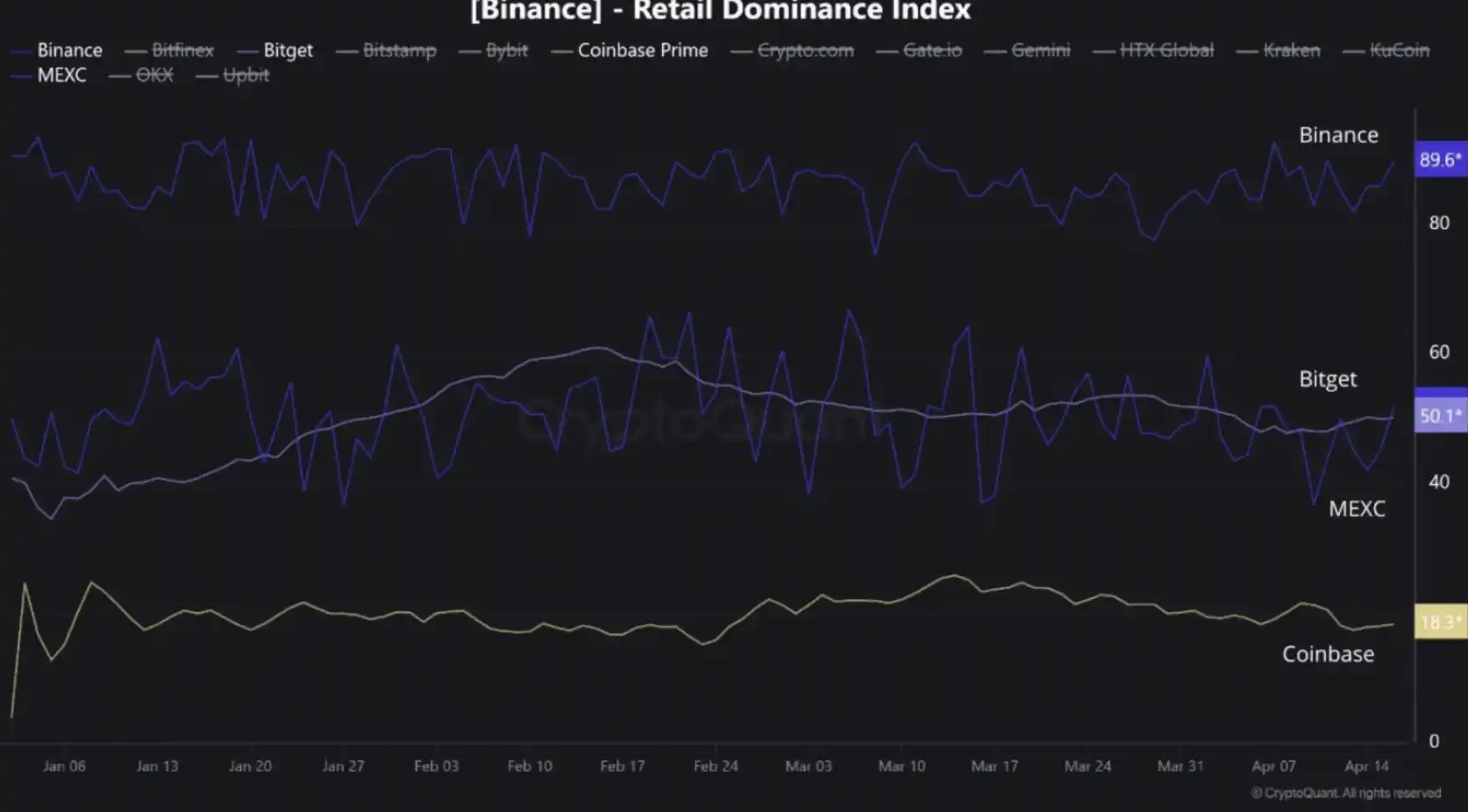
Image Source: CryptoQuant
Coinbase's "Mysterious Crediting"
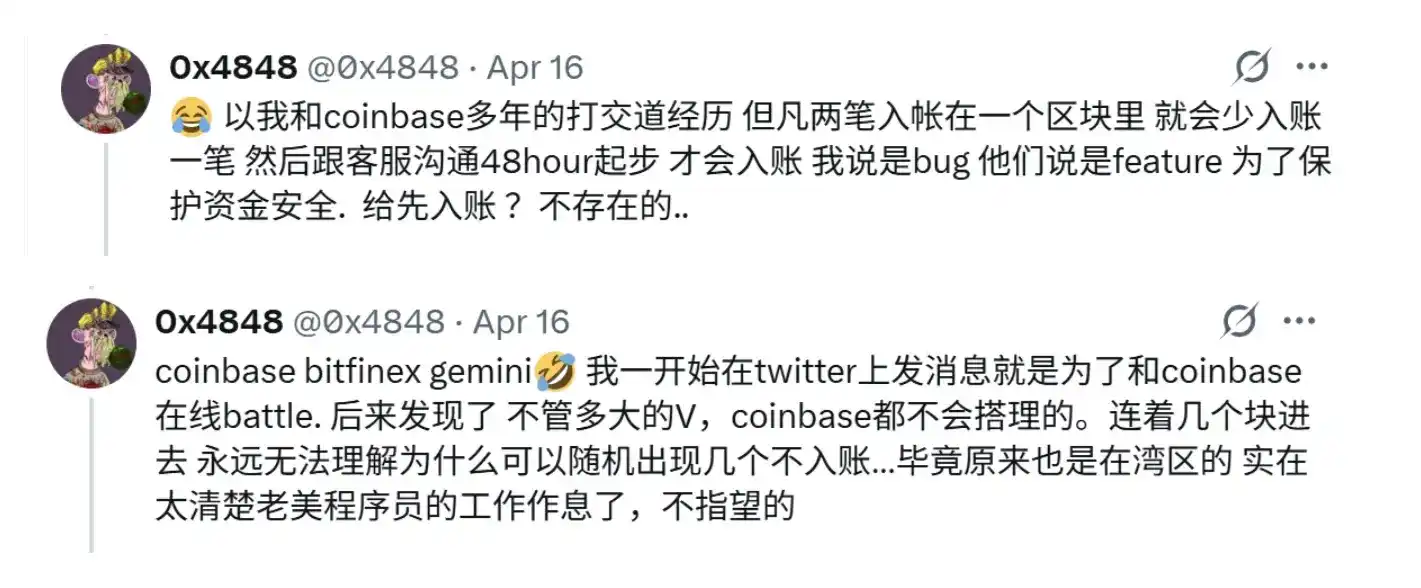
Some users have reported that when two transactions are processed in the same block, the Coinbase system may only credit one, while the other may take several days of back-and-forth with customer service to be restored. User @0x4848 said, "I said it was a bug, they said it was a feature, to protect the security of funds."
Issues of this kind, "in the name of security," can become an overdrawn of user patience and trust without an efficient and transparent resolution mechanism.
Customer Service: Slowness as the Norm
The customer support system of Coinbase has long been a "pain point hub." Many users have reported that Coinbase's chatbot is more of a hindrance than a help and cannot truly resolve issues.
Furthermore, once opting for human support, the nightmare of waiting truly begins. Human support agents have very limited authority and often can only "log the issue for further review." According to user feedback, receiving an initial response can take at least 48 hours, and fully resolving an issue may take a week or even longer.
Additionally, some users have described their support communication as chaotic and inefficient. "They keep going back and forth via email asking me for the same information, I provide it, then they say it's not enough," said user @MattLGov. "Dealing with Coinbase support is absolutely terrible."
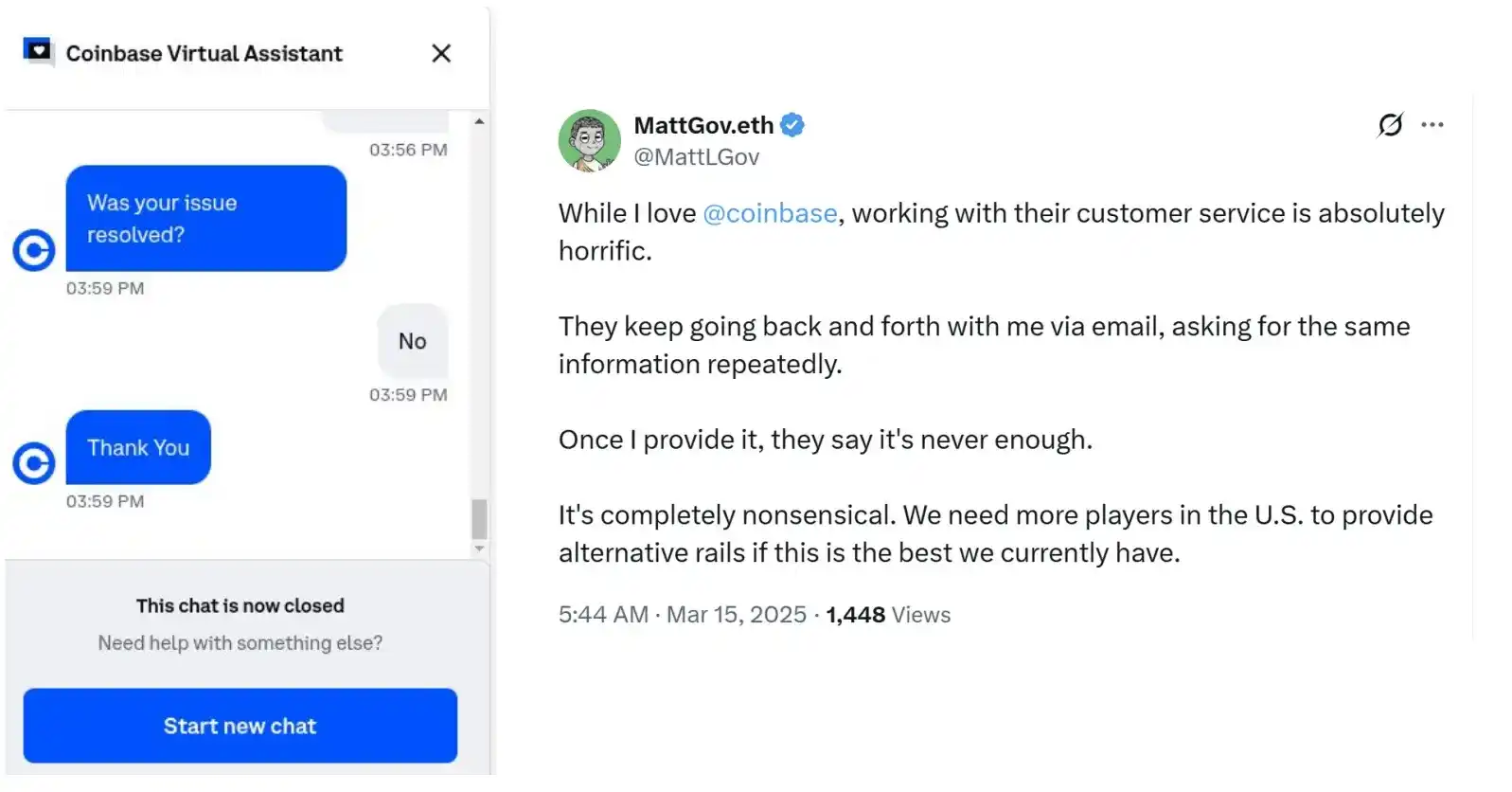
Image Source: @0x Ponga, @MattLGov
External Scams and Internal Breaches
Coinbase users are frequently targeted by scams. On-chain detective ZachXBT revealed that in just the past month, related incidents have caused up to $46 million in fund losses.
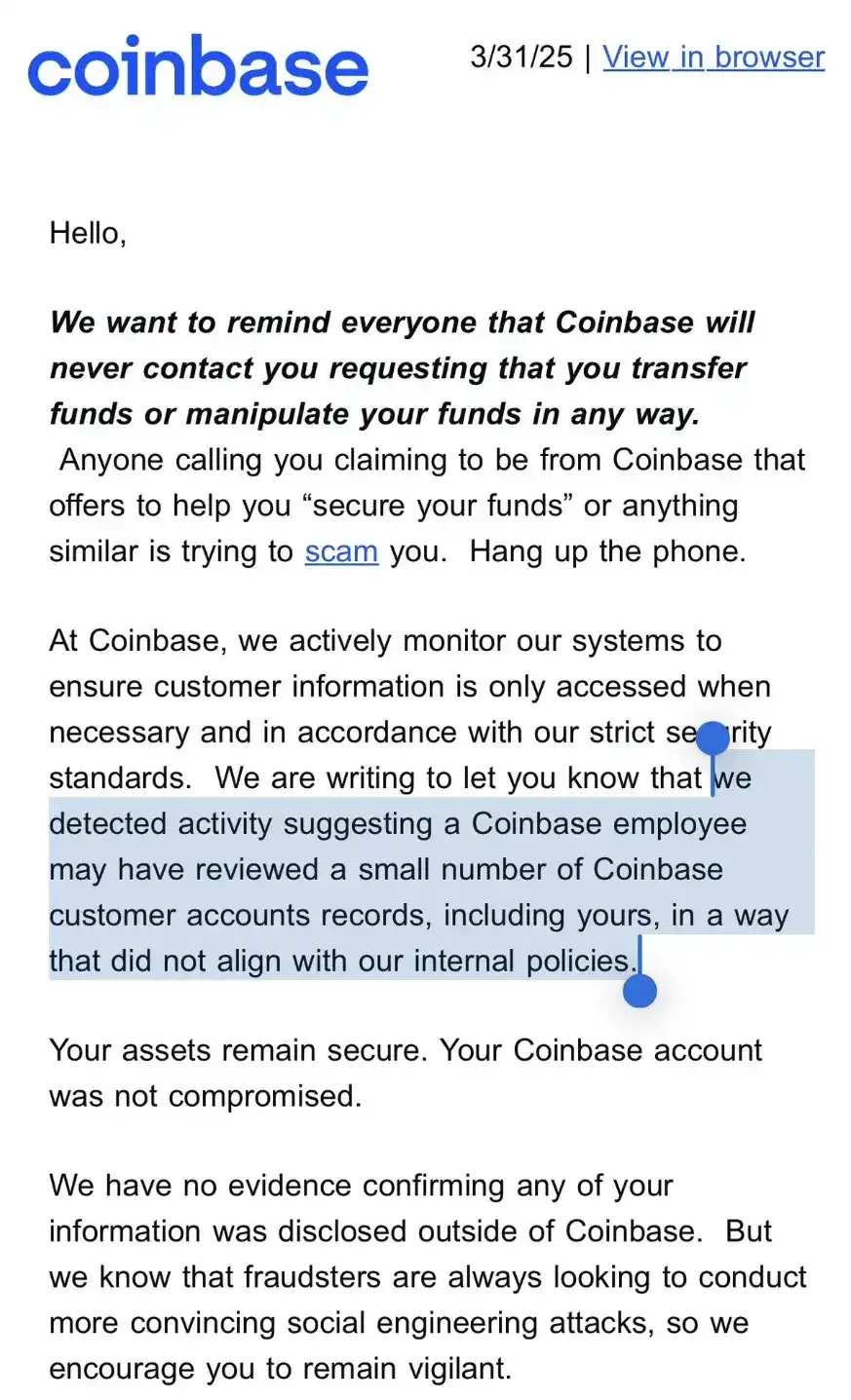
Meanwhile, internal data security issues have also surfaced at Coinbase. Mike Dudas, co-founder of The Block, shared on X platform that he received an official email indicating that an employee may have inappropriately accessed some user account data, including his own. The email stated: "We detected indications that an employee may have viewed a small number of customer account records in a way that may not be consistent with our internal policies." (Related Reading: Losing $300 million in a year, Coinbase users frequently targeted by precise scams, with an "insider" leaking information behind the scenes?)
"Read and Ignored" Coldness
When it comes to user communication, Coinbase's presence is almost non-existent. It does not cater to retail users and has not established an effective user feedback channel. Neither the CEO nor the executive team rarely publicly respond to user issues on social media. Even in the face of numerous complaints and doubts, their appearances to clarify or explain are extremely rare.
Behind this "silence," there may be cultural and regulatory considerations, but the result is that users' voices are hardly heard.
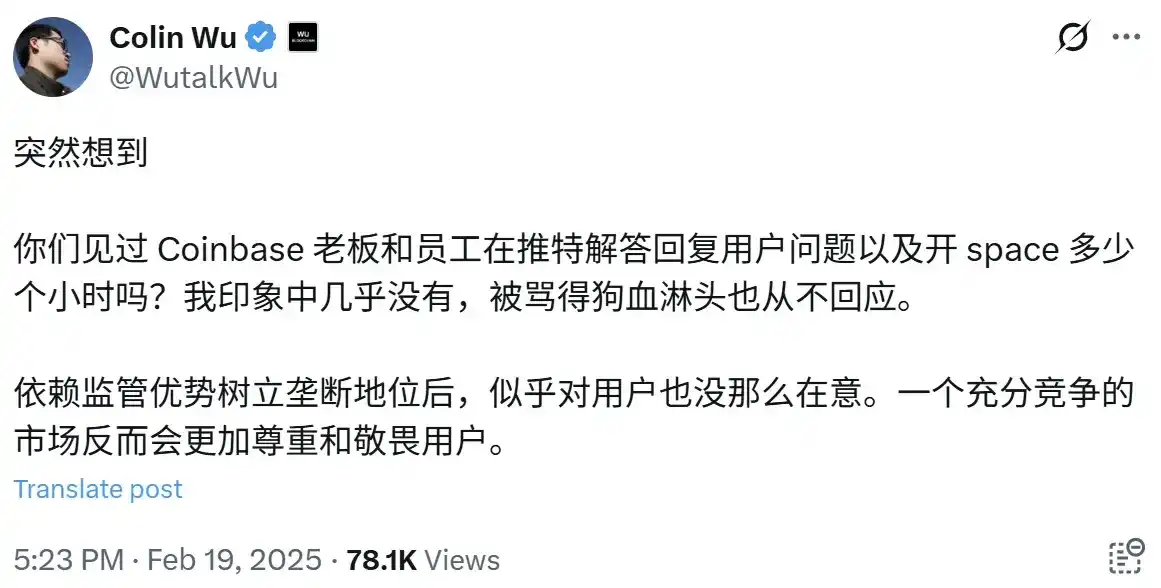
Image Source: @WutalkWu
「Noble Class」 Fee
User @hyperunit compiled the cost of purchasing 1 BTC spot price on mainstream trading platforms based on the initial fee level, showing that Coinbase's fee reached $329.68, ranking at a relatively high level. In addition, community user @Tmzhao 1 pointed out that in order to obtain the same fee level as a regular user on Binance on Coinbase, users need to start from VIP 0, complete approximately $250 million in trading volume, and pay over $300,000 in cumulative fees.
Although Coinbase Pro (now Advanced Trade) offers lower fee options, its interface is relatively complex, and many regular users are not familiar with it or find it easy to use.
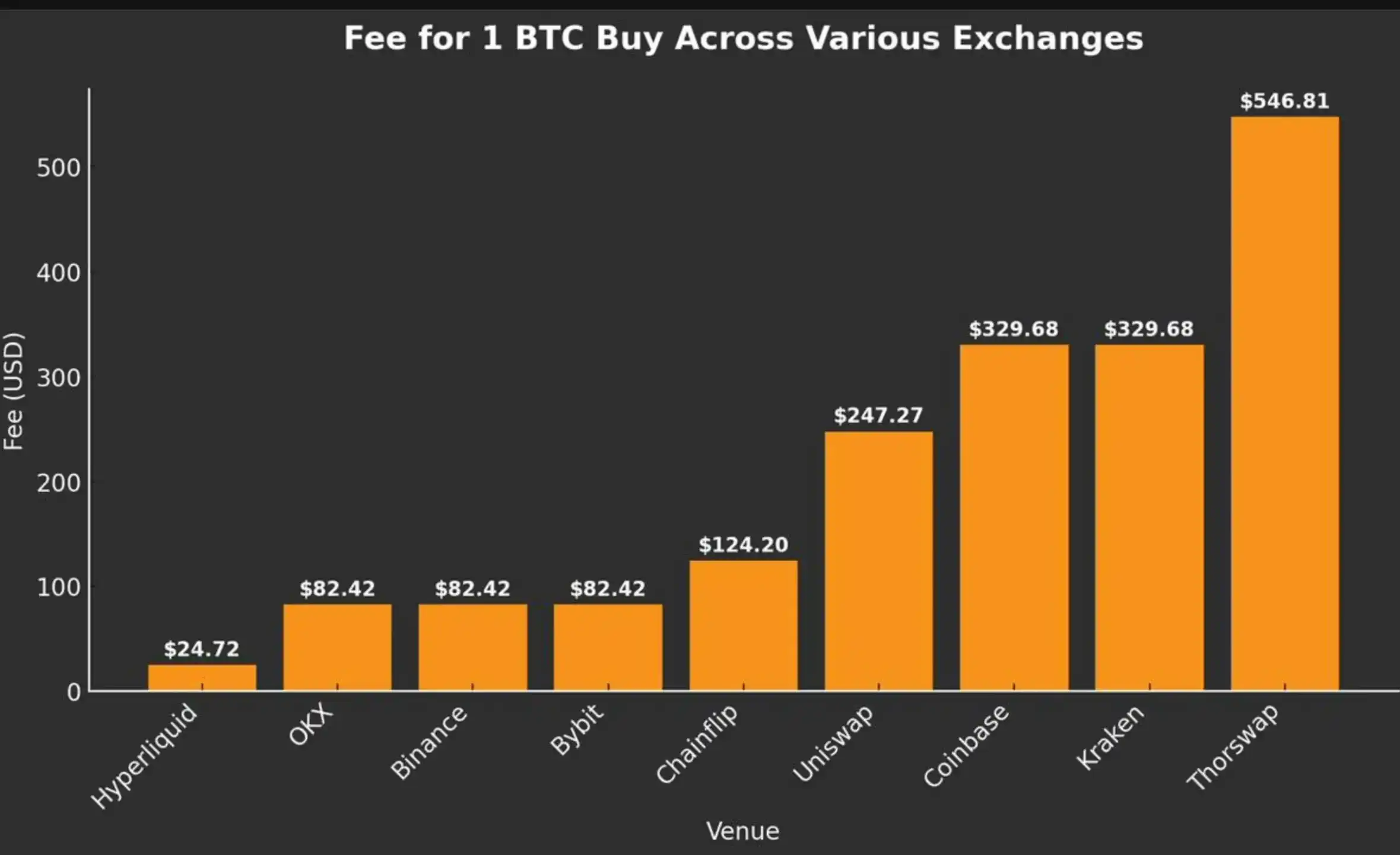
Image Source: @hyperunit
Undoubtedly, Coinbase's compliance halo is the cornerstone of its strong position in the U.S. market. However, as it continues to increase its reliance on institutions, it seems to gradually diminish its connection with ordinary users. On this path of pursuing compliance and security, Coinbase is quietly sacrificing user experience, giving up the meticulous polishing of platform operation and services.
Behind this advancing giant ship, there are scattered whispers and expectations of countless users, whose voices are gradually being drowned out in cumbersome processes and indifferent mechanisms.
You may also like

WEEX Deposit/Withdrawal Dynamic Island: Your Asset Status, Always in Sight

Scaling Crypto Derivatives: The Digital Asset Infrastructure Behind High-Volume Trading
In the fast-moving digital asset ecosystem, derivatives platforms face an extreme architectural test. High-leverage futures markets demand more than just standard security—they require absolute operational precision, zero-latency matching engines, and ironclad structural scalability, all while navigating intense market volatility.
As global platforms scale to meet these demands, the industry is shifting away from rigid, monolithic setups toward a more agile, "decoupled" infrastructure philosophy.
The Blueprint for High-Volume Copy TradingFor elite global exchanges like WEEX (founded in 2018), this architectural choice becomes critical when scaling high-volume retail features like social copy trading. When thousands of users automatically mirror the real-time strategies of elite traders simultaneously, it triggers sudden, monumental spikes in concurrent transactional volume.
To prevent execution latency or settlement bottlenecks during these peak volatility events, a platform's primary engine must remain entirely dedicated to risk management, copy-trade synchronization, and order matching.
The Architectural Rule: New-generation platforms must separate front-end user execution engines from heavy backend infrastructural overhead to eliminate operational friction.
By separating these layers, platforms can maintain complete sovereignty over their trading environments and user experiences while strategically aligning with institutional-grade infrastructure ecosystems. This strategic framework allows modern exchanges to leverage advanced Digital Asset Custody infrastructure such as Cobo’s behind the scenes, ensuring that backend wallet management scales elastically alongside trading spikes.
Capitalizing on Market Momentum and 400× LeverageIn a derivatives arena where platforms offer up to 400× leverage on perpetual contracts, capital efficiency and market agility are core business metrics. To capture market momentum, an exchange needs the ability to rapidly expand its asset offerings, supporting everything from legacy crypto assets to sudden, trending altcoins across a massive library of trading pairs.
Adopting a flexible, scalable Wallet-as-a-Service (WaaS) solution such as Cobo’s could completely rewrite the development timeline for high-growth exchanges. Instead of spending months of engineering capital building out custom backend wallet architectures for every new blockchain network, platforms can deploy localized infrastructure in days.
This agility allows platforms to instantly scale their listings to over a thousand trading pairs without compromising security or delaying time-to-market. It mirrors the exact operational advantages seen during high-velocity market events, similar to how advanced wallet infrastructure empowers platforms during sudden asset surges; allowing exchanges to pass that speed and liquidity directly to their global user base.
A Mature Foundation for GrowthThe synergy between trusted infrastructure ecosystems and global trading platforms represents the natural evolution of a maturing crypto market. As WEEX continues to scale its global spot and derivatives offerings for over 6 million users, adopting robust backend paradigms proves that platforms no longer have to compromise between cutting-edge trading velocity and uncompromised structural security.

Morning Report | BitMine increased its holdings by 126,971 ETH last week; trader Eugene announced his exit from the crypto market

Wang Chuan: How can one not feel anxious after the neighbor Old Wang made thirty times profit by investing in storage stocks? (Seven) - A quarter-century cycle

Get Paid to Onboard? Try WEEX’s New Homepage with Rewards for Registration, Deposit & Trade

WEEX Custom Layout: Build Your Perfect Trading Workspace in Seconds

See “Buy Walls” & “Sell Walls” Instantly: WEEX Launches the Depth Chart for Smarter Trades

What Is Quick Trade on WEEX? 2 Ways WEEX Ends Chart-Panel Jumping
Morning News | Five major virtual asset platforms in South Korea have experienced 57 incidents of hacking and system failures in six years; Grayscale submits registration application for Canton ETF

Should we escape the peak? The principle of the tail-end market in the stock market

RootData: May 2026 Cryptocurrency Exchange Transparency Research Report

Founder of Baixing.com: My Experience with Claude Code in Fourteen Points

Yang Ge Gary: Agent Economics and AI Microeconomics
When reasoning becomes a scarce resource, who captures its value?

Jensen Huang dramatically "rescues" the South Korean stock market

Stablecoins vs Deposit Tokens: On the surface, they seem like opposing sides, but in reality, they are interconnected

Bitcoin Crash to $50,000 or Bear Trap Before $100,000? Deep Dive for WEEX Traders
How Could the SpaceX IPO Affect Bitcoin, Altcoins season, and Crypto Liquidity?
WEEX Deposit/Withdrawal Dynamic Island: Your Asset Status, Always in Sight
Scaling Crypto Derivatives: The Digital Asset Infrastructure Behind High-Volume Trading
In the fast-moving digital asset ecosystem, derivatives platforms face an extreme architectural test. High-leverage futures markets demand more than just standard security—they require absolute operational precision, zero-latency matching engines, and ironclad structural scalability, all while navigating intense market volatility.
As global platforms scale to meet these demands, the industry is shifting away from rigid, monolithic setups toward a more agile, "decoupled" infrastructure philosophy.
The Blueprint for High-Volume Copy TradingFor elite global exchanges like WEEX (founded in 2018), this architectural choice becomes critical when scaling high-volume retail features like social copy trading. When thousands of users automatically mirror the real-time strategies of elite traders simultaneously, it triggers sudden, monumental spikes in concurrent transactional volume.
To prevent execution latency or settlement bottlenecks during these peak volatility events, a platform's primary engine must remain entirely dedicated to risk management, copy-trade synchronization, and order matching.
The Architectural Rule: New-generation platforms must separate front-end user execution engines from heavy backend infrastructural overhead to eliminate operational friction.
By separating these layers, platforms can maintain complete sovereignty over their trading environments and user experiences while strategically aligning with institutional-grade infrastructure ecosystems. This strategic framework allows modern exchanges to leverage advanced Digital Asset Custody infrastructure such as Cobo’s behind the scenes, ensuring that backend wallet management scales elastically alongside trading spikes.
Capitalizing on Market Momentum and 400× LeverageIn a derivatives arena where platforms offer up to 400× leverage on perpetual contracts, capital efficiency and market agility are core business metrics. To capture market momentum, an exchange needs the ability to rapidly expand its asset offerings, supporting everything from legacy crypto assets to sudden, trending altcoins across a massive library of trading pairs.
Adopting a flexible, scalable Wallet-as-a-Service (WaaS) solution such as Cobo’s could completely rewrite the development timeline for high-growth exchanges. Instead of spending months of engineering capital building out custom backend wallet architectures for every new blockchain network, platforms can deploy localized infrastructure in days.
This agility allows platforms to instantly scale their listings to over a thousand trading pairs without compromising security or delaying time-to-market. It mirrors the exact operational advantages seen during high-velocity market events, similar to how advanced wallet infrastructure empowers platforms during sudden asset surges; allowing exchanges to pass that speed and liquidity directly to their global user base.
A Mature Foundation for GrowthThe synergy between trusted infrastructure ecosystems and global trading platforms represents the natural evolution of a maturing crypto market. As WEEX continues to scale its global spot and derivatives offerings for over 6 million users, adopting robust backend paradigms proves that platforms no longer have to compromise between cutting-edge trading velocity and uncompromised structural security.
Morning Report | BitMine increased its holdings by 126,971 ETH last week; trader Eugene announced his exit from the crypto market
Wang Chuan: How can one not feel anxious after the neighbor Old Wang made thirty times profit by investing in storage stocks? (Seven) - A quarter-century cycle
Get Paid to Onboard? Try WEEX’s New Homepage with Rewards for Registration, Deposit & Trade
WEEX Custom Layout: Build Your Perfect Trading Workspace in Seconds


