
Monero's Market Cap Surges $1.5 Billion in One Day: Why Aren't Hackers Loving Bitcoin Anymore?

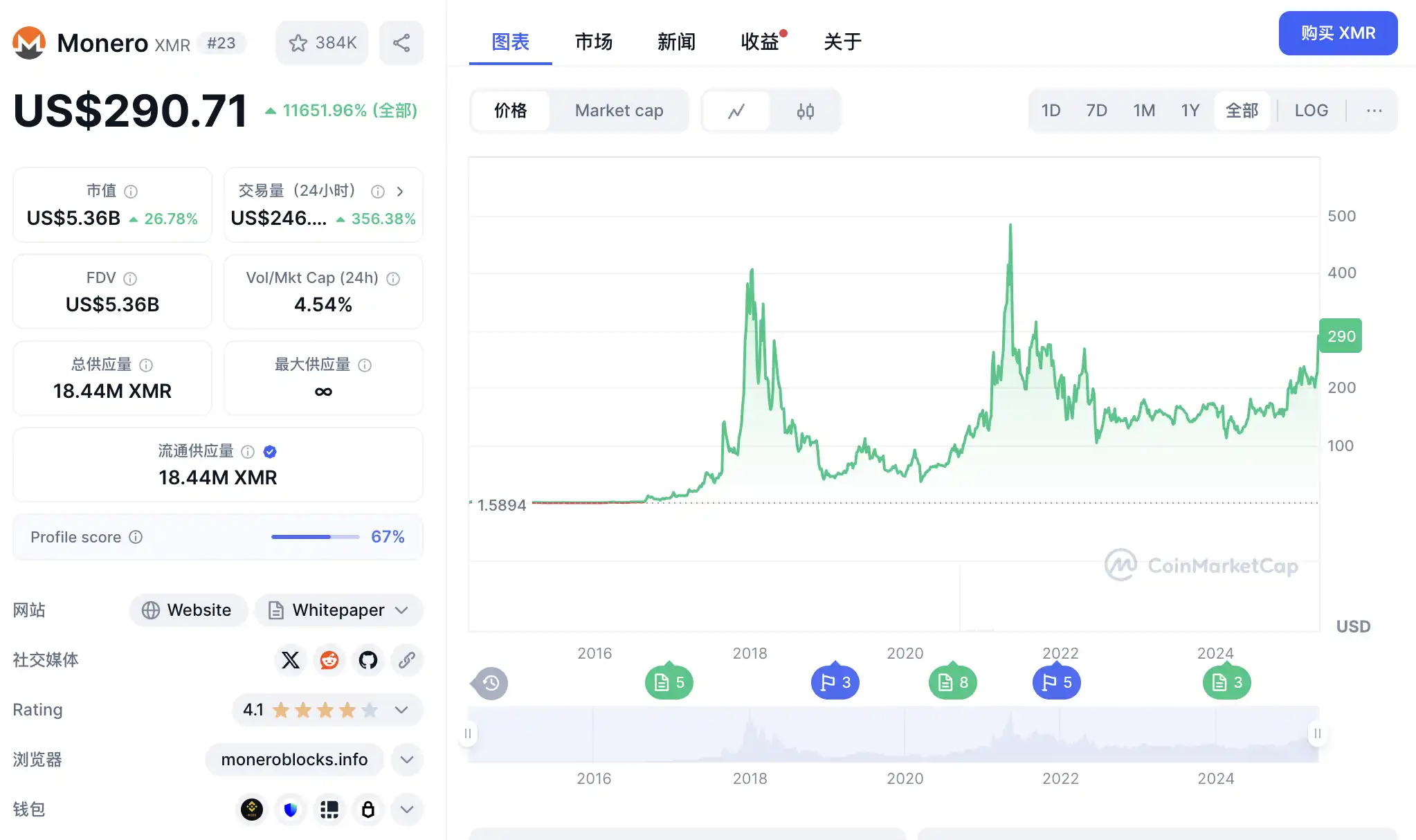
Yesterday, the "ancient" privacy coin Monero ($XMR), which had been silent for a long time, suddenly surged. It skyrocketed 30% in a single day, reaching a peak price of $329, marking a new high since 2021. What is this 11-year-old old coin? And why did it suddenly surge?
The Most OG Privacy Coin
In 2013, Nicolas van Saberhagen published the "CryptoNote" protocol, upon which Monero was born in April 2014 and transitioned to RandomX in 2019.
Monero uses technologies such as ring signatures, stealth addresses, and RingCT to hide the transaction sender, receiver, and amount. This high level of anonymity gives it an advantage in terms of privacy protection. Monero's modular code structure has been appreciated by one of the Bitcoin core maintainers, Wladimir J. van der Laan.
However, while maintaining privacy, it also makes it difficult to meet regulatory anti-money laundering (AML) and counter-terrorism financing (CTF) requirements. As one of the most well-known privacy coins, it is a token with two sides. On the one hand, it focuses on privacy, decentralization, and scalability, which is loved by many who embrace liberalism. On the other hand, it has also become a breeding ground for criminals.
A Criminal's "Favorite"
In the late summer of 2016, with the arrest of "Silk Road" founder Ross William Ulbricht, law enforcement agencies gained traceability technology for Bitcoin. Major darknet markets like AlphaBay began to abandon Bitcoin in favor of the more untraceable Monero. North Korea's Lazarus Group hackers also favored using Monero to "clean" assets, leading Monero to experience its first market capitalization breakthrough in 2016, going from $5 million to $185 million, accompanied by rapid transaction volume growth.
2020 was the second hot period for Monero. That year, the terrorist organization ISIS updated its website, stating they would no longer accept Bitcoin donations and instead switch to the more private Monero. The reason is if ISIS had a large Bitcoin reserve, as a terrorist organization, it might be difficult to transfer or cash out, as confirmed in a report by Chainalysis, stating ISIS held less than $100,000 in Bitcoin, similar to most other terrorist organizations. Also in the same year, darknet market sales increased by 70% YoY, with Monero becoming one of the main payment tools due to its privacy features, accounting for 45% of the market, almost on par with Bitcoin.
Dark web transactions, fraud, ransomware extortion, and hackers' coin laundering have made Monero infamous, thanks to the widespread adoption in "underground trade." In 2020, XMR's token price rose from $50 at the beginning of the year to $150 by the end of the year, reaching $450 by mid-2021.
Key of Freedom
Although Monero has long been associated with "crime," it is just a technological tool. The Monero development team has always maintained a "code neutrality" stance. They emphasize that "Monero is designed for the everyday use of ordinary people, and any technology can be misused, just like cash." They do not cooperate with criminal activities nor have any connections to criminal organizations.
Therefore, from another perspective, it upholds the "transaction freedom" of Bitcoin and is highly supported by many geeks who advocate "libertarianism," "privacy first," and "decentralization against censorship." Many in the community believe it is the real Bitcoin.
John McAfee, the founder of the first antivirus software McAfee, is one of them. He stated in numerous occasions before his death that "Monero is one of the truly anonymous cryptocurrencies, while Bitcoin is not truly anonymous." He admired Monero's technical prowess and privacy features. The anonymity and untraceability of Monero align well with McAfee's long-standing advocacy of "privacy libertarianism."
Even the "Bitcoin Jesus" Roger Ver "defected." In his first public interview after being released on bail in 2024, Roger stated that he decided to abandon Bitcoin and instead favor tokens like Monero, which can provide more privacy. "Most people are now using custodial wallets, which are not wallets at all but merely accounts. They offer no more privacy than your account at a U.S. bank or on PayPal. Fortunately, there are other cryptocurrencies like Monero that can provide more privacy protection."
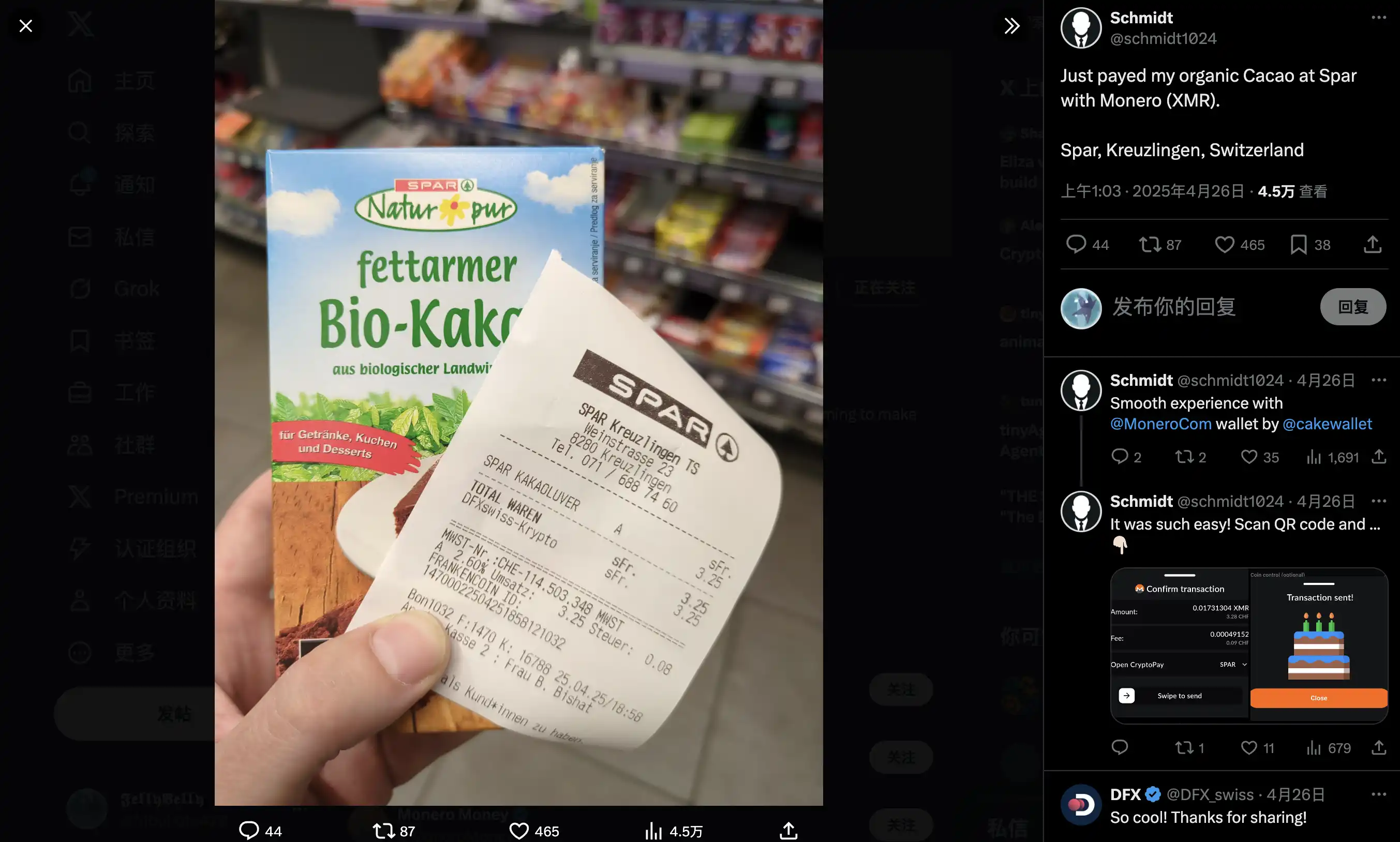
In regions with active cryptocurrency communities, some e-commerce or independent merchants accept Monero as a payment method, such as some tech-related online stores selling "hardware wallets or cryptocurrency peripheral tech products," or offline retail stores. Community member Schmidt even shared a receipt for purchasing a low-fat organic cocoa drink at Spar using Monero.
Note: SPAR is one of the world's largest food retail chains, founded in 1932 by Adriaan van Well in the Netherlands. With over 13,900 stores across 48 countries, the Kloten store purchased by the community member is in Switzerland and has garnered attention for accepting cryptocurrency assets such as Bitcoin and Monero.
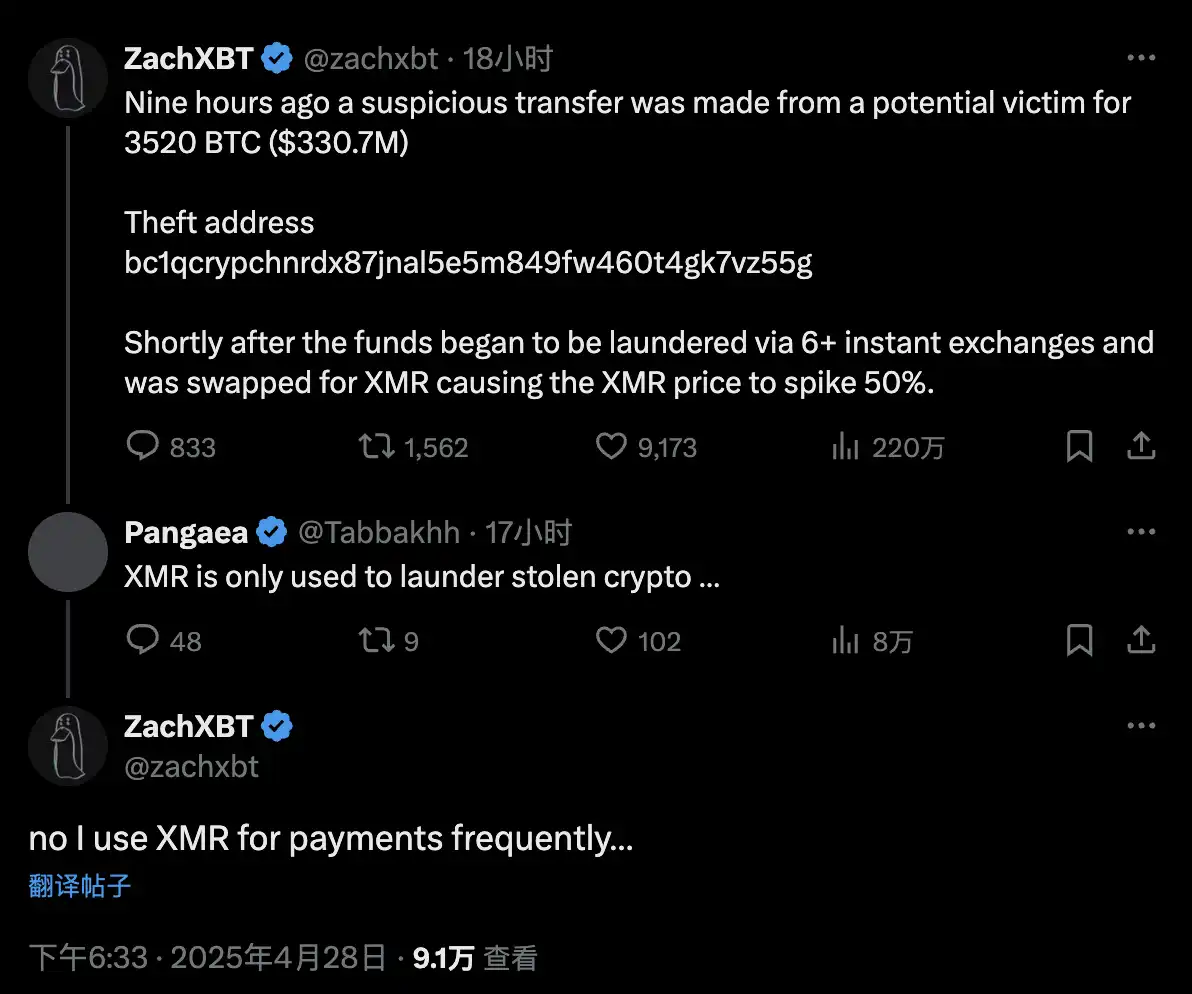
When the Monero community was criticized for using Monero as a "privacy coin for money laundering," renowned on-chain detective ZachXBT countered by saying, "No, I often use Monero for payments," indicating that he is also a Monero enthusiast.
Short-term Pump or Price Discovery?
Stolen Funds Flowing In
On social media, on-chain detective ZachXBT posted, "Nine hours ago, a suspicious transaction occurred from a certain address, involving 3520 Bitcoins (approximately $330.7 million). Subsequently, these funds were laundered through more than 6 instant trading platforms and converted into Monero, causing a 50% surge in Monero's price."
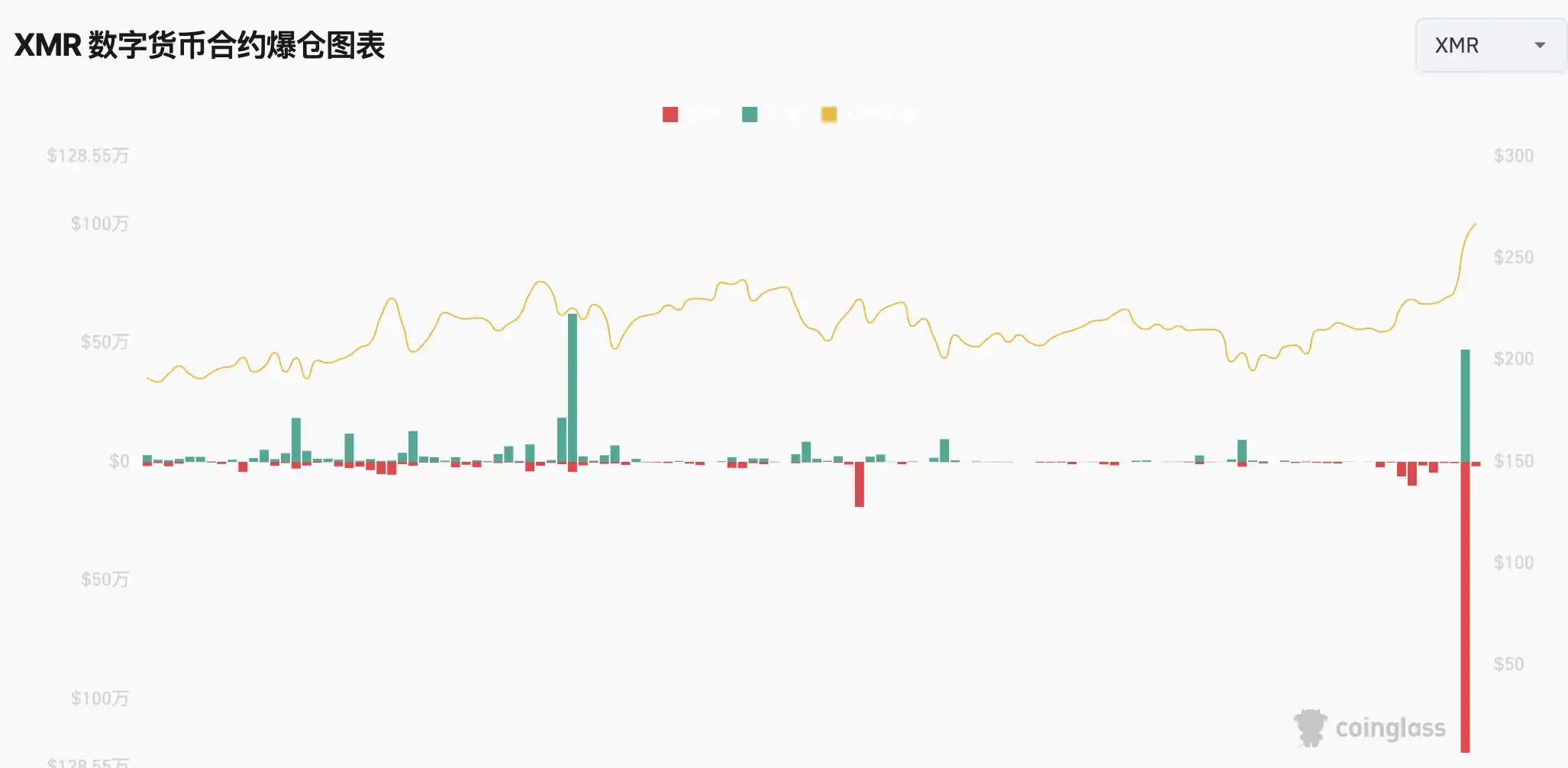
This also led to a massive closure of short positions on the token, forcing traders to buy back assets. With the increasing demand for spot trading, this further added to the upward pressure. These combined factors may have contributed to Monero's recent sudden surge.
Positive Project Developments
Some analysts believe that the growing anticipation of the Monero EP159 and EP160 upgrade proposals is also one of the factors behind this surge. This proposal would make Monero more compliance-friendly, allowing users to provide transaction proof without exposing sensitive private information. The community believes that this upgrade may see Monero, which was delisted from major CEX exchanges following the 2024 EU update on anti-money laundering regulations, relisted on compliant top-tier CEXs such as Binance and Coinbase.
Additionally, the first DeFi project in the Monero ecosystem, Tari, is set to launch and merge mine with Monero, with its mainnet scheduled to go live on May 6th. Many in the Monero community are eagerly anticipating the arrival of this project.

Once a tool is created, concepts of good and evil imbue it with various meanings. Monero is now a symbol of cryptocurrency, balancing between "freedom" and "regulation," and hovering between "human rights" and "crime." The inherent good and evil of human nature are infinitely magnified here, much like when Einstein commented on the atomic bomb, saying, "Science and technology are a double-edged sword; they can benefit humanity or destroy the world."
You may also like

Japan’s Three Megabanks Plan Joint Stablecoin Issuance in Fiscal 2026
MUFG, SMBC, and Mizuho reportedly plan to jointly issue fiat-pegged stablecoins in fiscal 2026, signaling Japan’s growing push into bank-led digital payment infrastructure.

Humanity Discloses H Token Dual-Chain Attack Details, With Losses on Ethereum and BSC Exceeding $36 Million
Humanity said the H token attack across Ethereum and BSC caused more than $36 million in losses after leaked ProxyAdmin keys enabled malicious contract upgrades and token minting.

White House Discusses CLARITY Act With Law Enforcement Ahead of Senate Vote
The White House discussed the CLARITY Act with law enforcement ahead of a Senate vote, focusing on illicit finance risks and developer protections.

$75 billion in foreign capital has fled, and South Korean retail investors have absorbed it all using leverage

Bitcoin Trading Guide 2026: Strategies for Experienced Traders

What Is XAUT and PAXG? Why Tokenized Gold Is Booming in 2026

Cryptocurrency CEXs are flocking to sell US stocks, and traditional brokerages are facing an "uninvited guest."

Will the SpaceX IPO Hurt Bitcoin? Here's What Traders Are Watching
Foreign selling in the South Korean stock market accelerates, with cumulative net sales reportedly reaching $75 billion this year
On June 9, The Kobeissi Letter, citing Goldman Sachs data, reported that global investors are selling South Korean stocks at an unusually rapid pace. In the latest trading session, foreign investors sold about $801 million worth of Kospi constituent stocks again; total foreign outflows last week reached about $10 billion, and the market has been in net foreign selling on nearly every trading day over the past month. According to the data cited in the report, foreign investors have sold about $75 billion worth of South Korean stocks so far this year. Meanwhile, South Korean retail and institutional investors together recorded roughly $69 billion in net buying over the same period, suggesting that the market’s main buying support has come from domestic capital rather than returning overseas funds. The information currently disclosed still mainly comes from The Kobeissi Letter’s retelling and Goldman Sachs data summaries, while public details on the statistical period and the specific definition of “selling” remain relatively limited.

Fortune Warns of Strategy’s Financing Structure Risks as Bitcoin Premium Narrows
Fortune warned that Strategy’s Bitcoin treasury model faces growing financing risks as MSTR’s net asset premium narrows and preferred stock dividend pressure increases.

Ferrari Challenge Le Mans: Carl Moon to Dominate in WEEX Livery

Sahara AI Responds to SAHARA’s Sharp Drop: No Contract or Product Security Issues Found, Internal Investigation Underway
Sahara AI responded to SAHARA’s 60% price drop, saying no token contract or product security issues have been found and an internal investigation is underway.

WEEX Deposit/Withdrawal Dynamic Island: Your Asset Status, Always in Sight
Scaling Crypto Derivatives: The Digital Asset Infrastructure Behind High-Volume Trading
In the fast-moving digital asset ecosystem, derivatives platforms face an extreme architectural test. High-leverage futures markets demand more than just standard security—they require absolute operational precision, zero-latency matching engines, and ironclad structural scalability, all while navigating intense market volatility.
As global platforms scale to meet these demands, the industry is shifting away from rigid, monolithic setups toward a more agile, "decoupled" infrastructure philosophy.
The Blueprint for High-Volume Copy TradingFor elite global exchanges like WEEX (founded in 2018), this architectural choice becomes critical when scaling high-volume retail features like social copy trading. When thousands of users automatically mirror the real-time strategies of elite traders simultaneously, it triggers sudden, monumental spikes in concurrent transactional volume.
To prevent execution latency or settlement bottlenecks during these peak volatility events, a platform's primary engine must remain entirely dedicated to risk management, copy-trade synchronization, and order matching.
The Architectural Rule: New-generation platforms must separate front-end user execution engines from heavy backend infrastructural overhead to eliminate operational friction.
By separating these layers, platforms can maintain complete sovereignty over their trading environments and user experiences while strategically aligning with institutional-grade infrastructure ecosystems. This strategic framework allows modern exchanges to leverage advanced Digital Asset Custody infrastructure such as Cobo’s behind the scenes, ensuring that backend wallet management scales elastically alongside trading spikes.
Capitalizing on Market Momentum and 400× LeverageIn a derivatives arena where platforms offer up to 400× leverage on perpetual contracts, capital efficiency and market agility are core business metrics. To capture market momentum, an exchange needs the ability to rapidly expand its asset offerings, supporting everything from legacy crypto assets to sudden, trending altcoins across a massive library of trading pairs.
Adopting a flexible, scalable Wallet-as-a-Service (WaaS) solution such as Cobo’s could completely rewrite the development timeline for high-growth exchanges. Instead of spending months of engineering capital building out custom backend wallet architectures for every new blockchain network, platforms can deploy localized infrastructure in days.
This agility allows platforms to instantly scale their listings to over a thousand trading pairs without compromising security or delaying time-to-market. It mirrors the exact operational advantages seen during high-velocity market events, similar to how advanced wallet infrastructure empowers platforms during sudden asset surges; allowing exchanges to pass that speed and liquidity directly to their global user base.
A Mature Foundation for GrowthThe synergy between trusted infrastructure ecosystems and global trading platforms represents the natural evolution of a maturing crypto market. As WEEX continues to scale its global spot and derivatives offerings for over 6 million users, adopting robust backend paradigms proves that platforms no longer have to compromise between cutting-edge trading velocity and uncompromised structural security.

Morning Report | BitMine increased its holdings by 126,971 ETH last week; trader Eugene announced his exit from the crypto market

Wang Chuan: How can one not feel anxious after the neighbor Old Wang made thirty times profit by investing in storage stocks? (Seven) - A quarter-century cycle

Get Paid to Onboard? Try WEEX’s New Homepage with Rewards for Registration, Deposit & Trade
WEEX Custom Layout: Build Your Perfect Trading Workspace in Seconds
Japan’s Three Megabanks Plan Joint Stablecoin Issuance in Fiscal 2026
MUFG, SMBC, and Mizuho reportedly plan to jointly issue fiat-pegged stablecoins in fiscal 2026, signaling Japan’s growing push into bank-led digital payment infrastructure.
Humanity Discloses H Token Dual-Chain Attack Details, With Losses on Ethereum and BSC Exceeding $36 Million
Humanity said the H token attack across Ethereum and BSC caused more than $36 million in losses after leaked ProxyAdmin keys enabled malicious contract upgrades and token minting.
White House Discusses CLARITY Act With Law Enforcement Ahead of Senate Vote
The White House discussed the CLARITY Act with law enforcement ahead of a Senate vote, focusing on illicit finance risks and developer protections.
$75 billion in foreign capital has fled, and South Korean retail investors have absorbed it all using leverage
Bitcoin Trading Guide 2026: Strategies for Experienced Traders
What Is XAUT and PAXG? Why Tokenized Gold Is Booming in 2026


