
SKR Open for Withdrawal, Is the Solana Mobile Ecosystem Ready for the Second Half?



Original Title: SKR Open for Claiming, Is Solana Mobile Worth Watching?
Original Author: Chloe, ChainCatcher at ChainCatcher
With Solana Mobile officially launching its native token SKR today (21), it marks the transition of its incentive mechanism from the first-generation phone Saga's "random wealth effect" to the second-generation Seeker's more scalable and sustainable "mobile ecosystem economy" transformation.
This article elaborates on SKR's tokenomics and presents a neutral observation on its long-term development: discussing the potential future challenges facing Solana Mobile, and how SKR, as a "launch lever," is driving the application ecosystem growth on its open platform.
SKR Officially Open for Claiming, Price Performance?
Solana Mobile officially opened SKR token claiming today (21). As the first native asset in the Solana ecosystem that deeply binds phone holders, developers, and protocol incentives, SKR's launch has attracted high market attention.
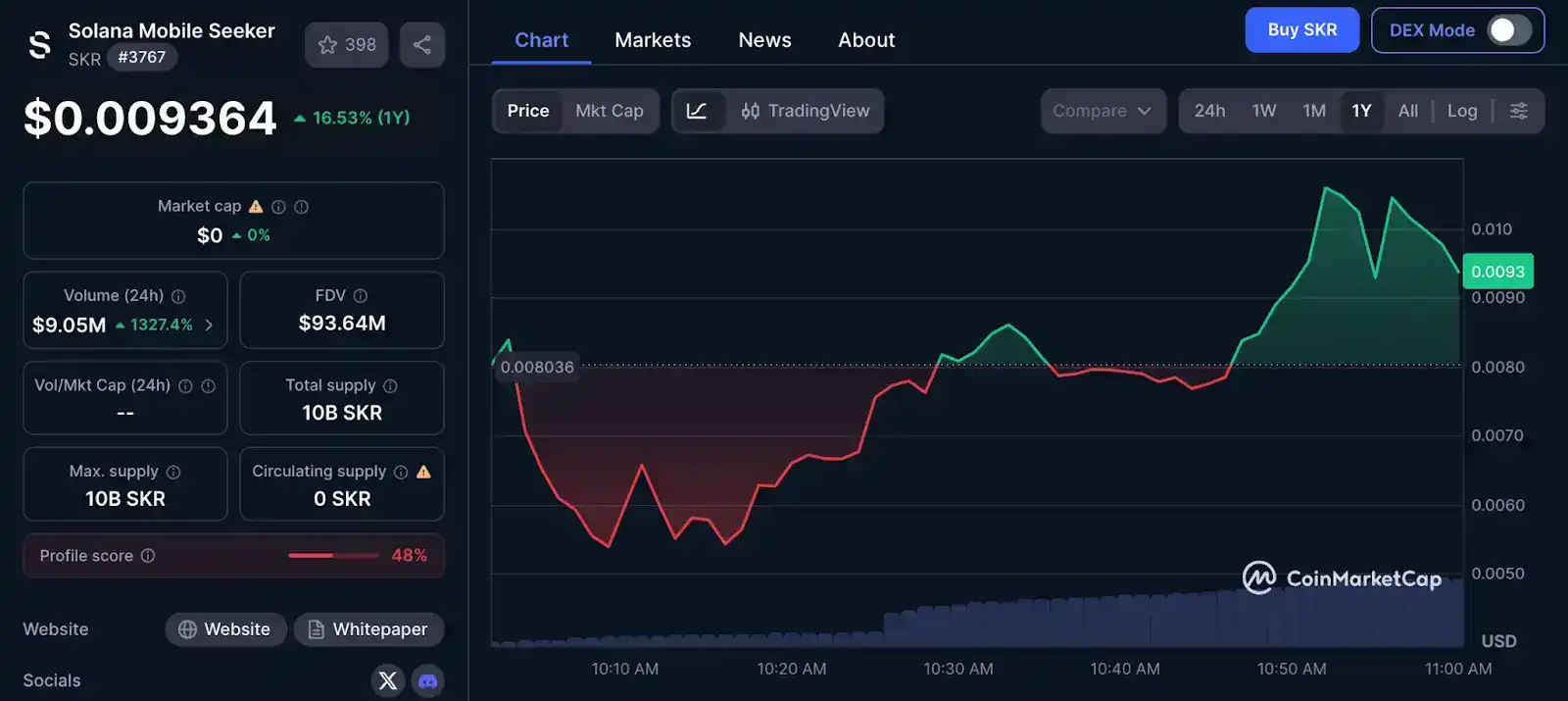
According to data, SKR fluctuated between $0.006 and $0.01 in the first hour of trading. Based on the current market price of around $0.0095 at the time of writing, the initial Scout tier holders received an airdrop value of $47.5; while the highest Sovereign tier holders received up to $7,125, a return of over 14 times compared to the initial Seeker phone's presale cost of about $450 to $500.
However, as the first wave of liquidity is released, the market is also monitoring the staking ratio of long-term holders, which will determine whether SKR can transition from short-term speculation to long-term governance incentive.
Solana Mobile's Vision and the Mission of Second-Generation Phone, Seeker
In its vision, Solana Mobile points out that the current mobile network ecosystem is under the long-term monopoly of Apple and Google. These two giants not only control the release and payment channels of applications but also hold the power to set the rules, which goes against the open spirit of Web3. Therefore, Solana Mobile's mission is not just to create mobile hardware but to establish a true alternative: an open, permissionless mobile platform.
Reflecting on the viral success of the first-generation Saga phone, while tinged with a level of serendipity, its value largely stemmed from random airdrops of third-party projects (such as the BONK token), this "blind box-style" wealth effect, while successfully attracting attention, also sparked doubts about the sustainability of the incentive model.
To transform this fragmented traffic into long-term, predictable ecological growth momentum, Solana Mobile has launched the second-generation Seeker phone and simultaneously kicked off the Seeker Season series of ecological incentive plans. Seeker is not only a hardware performance upgrade but also a ticket to enter the Solana Mobile ecosystem.
Since its shipment commencement in August 2025, Seeker's pre-orders have exceeded 150,000 units. Its core competitiveness lies in the transformation of the incentive mechanism: by issuing the native token SKR, the official platform has formally shifted from relying on third-party random rewards to a systematized incentive structure, aiming to achieve deep alignment of user, developer, and platform interests.
SKR Tokenomics and TEEPIN Architecture
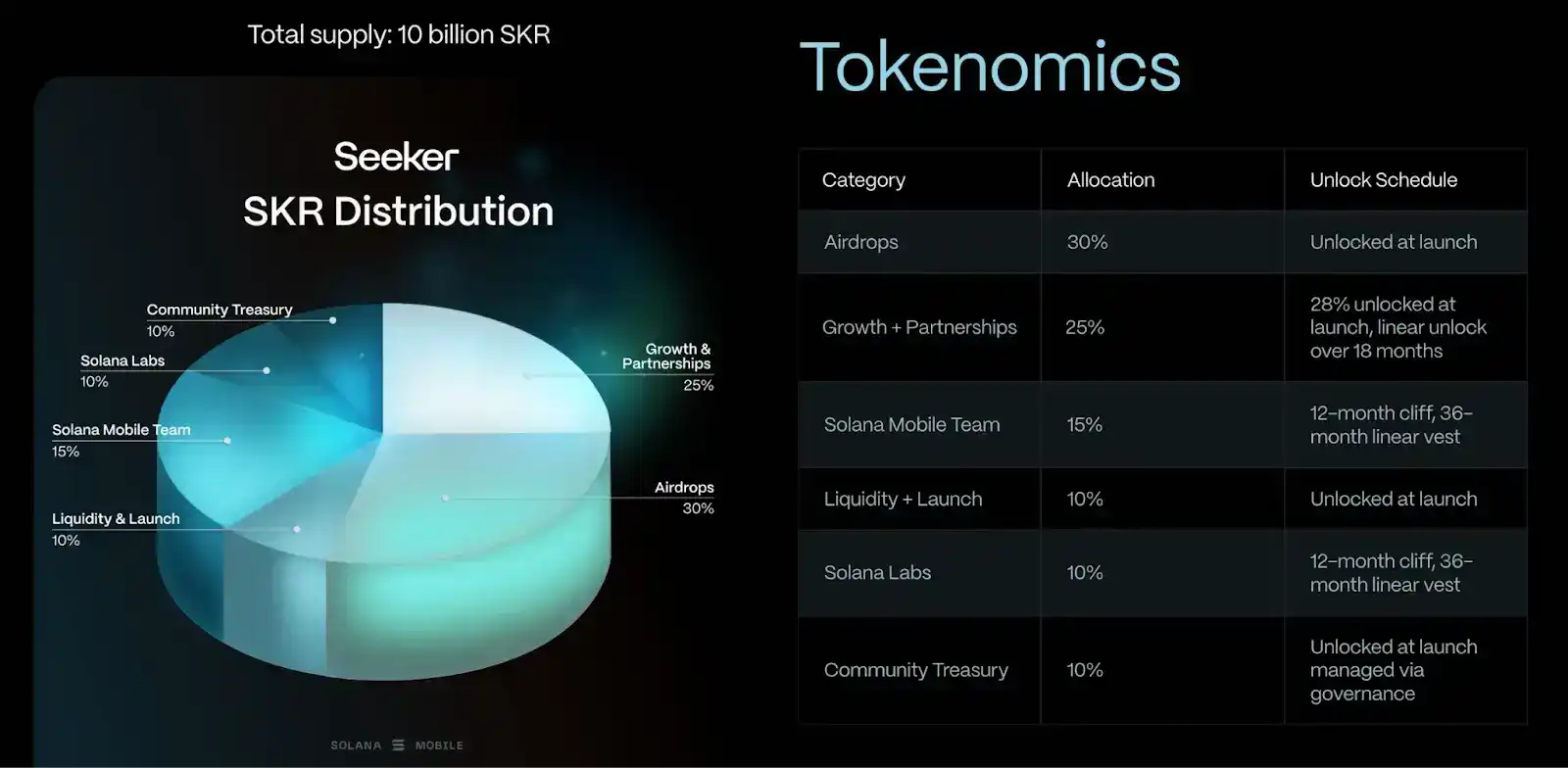
According to official disclosures, the initial total supply of SKR is set at 10 billion tokens, and it adopts a linearly decreasing inflation model to balance early development with long-term stability, setting the initial year's inflation rate at 10%, followed by a 25% annual decrement, ultimately stabilizing at a 2% inflation rate. Solana Mobile seeks to build an interest-aligned "ecosystem flywheel" through SKR, driving the sustainable development of decentralized mobile hardware and crypto app ecosystems.
The official mentioned that in Seeker's first season, nearly 2 billion SKR tokens were allocated to ecosystem contributors, accounting for 20% of the total supply. After an anti-whale attack review, a total of 100,908 users were eligible.
The user allocation tiers are as follows:
· Scout: 5,000 SKR
· Prospector: 10,000 SKR
· Vanguard: 40,000 SKR
· Luminary: 125,000 SKR
· Sovereign: 750,000 SKR
Additionally, to incentivize early developers, 141 million SKR will be allocated to 188 developers who list high-quality apps in the Seeker ecosystem, with each developer receiving 750,000 SKR.
The Tokenomics and Vesting Periods are as follows:
· Airdrop Allocation: 30% (unlocked upon listing)
· Growth & Partnerships: 25% (28% unlocked upon listing, remaining linearly unlocked over 18 months)
· Team Allocation: 15% (1-year cliff, then linearly unlocked over 36 months)
· Liquidity & Launch: 10% (unlocked upon listing)
· Solana Labs: 10% (1-year cliff, then linearly unlocked over 36 months)
· Community Treasury: 10% (unlocked upon listing, governed by governance).
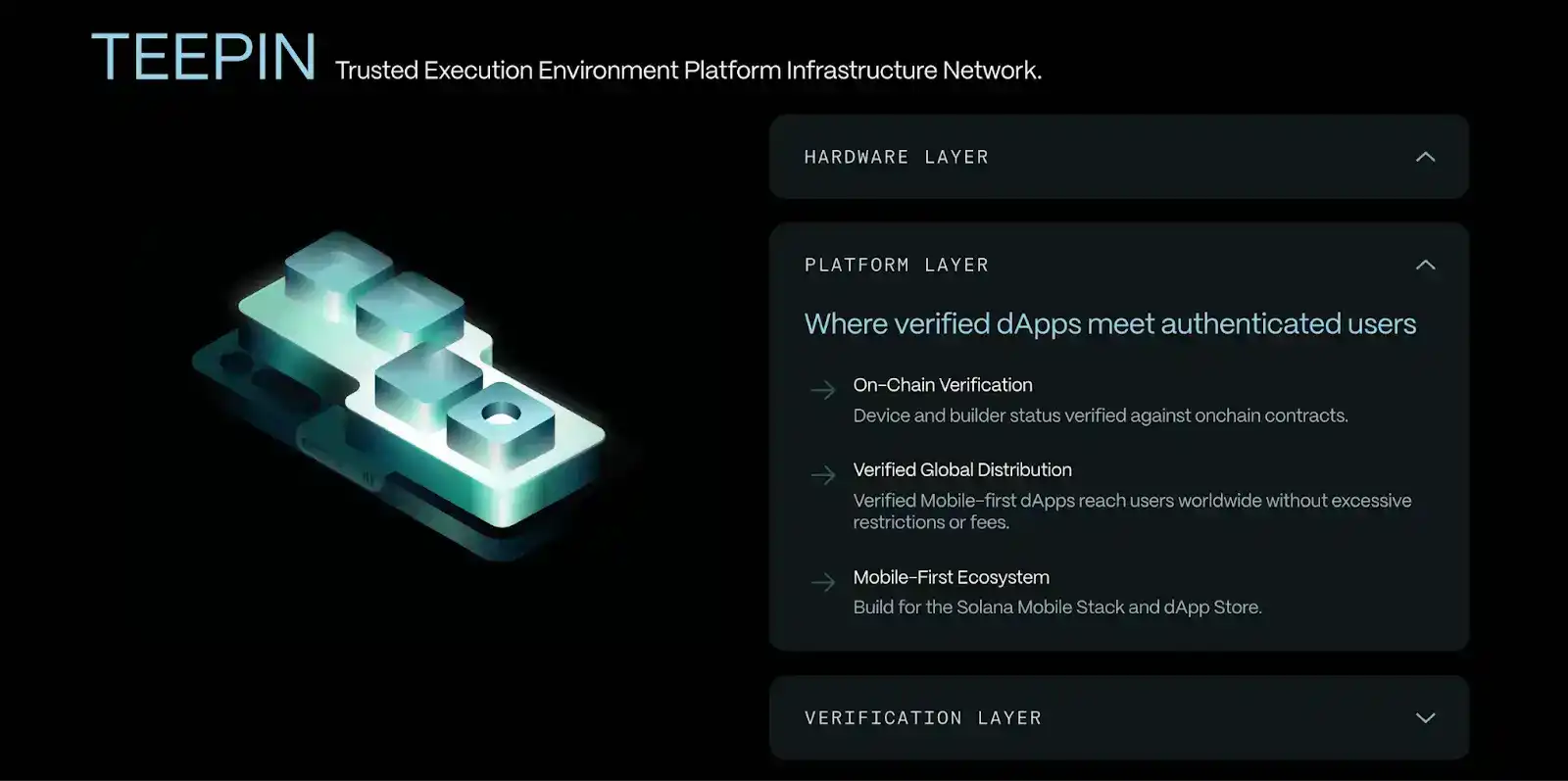
The core value of SKR lies in its support for TEEPIN (Trusted Execution Environment Platform Infrastructure Network).
In 2026, SKR holders can stake their tokens with "Guardians." Guardians are operators responsible for ensuring platform security, including:
1. Verifying Device Identity: Ensuring hardware and software integrity.
2. Auditing the App Store: Reviewing submissions to the decentralized app store.
3. Enforcing Community Standards: Upholding rules set by the community.
4. Distributing Staking Rewards: Staking SKR with Guardians allows participation in governance and rewards for securing the network.
Teams including Anza, DoubleZero, Triton, Helius, and Jito have joined as initial Guardians. Solana Mobile notes that this multi-operator model ensures no single entity can control the auditing or validation process, laying the foundation for an open mobile platform.
SKR Airdrop Claim, Staking, and Seeker Season 2 Outlook
With the official launch of SKR, eligible users are now in the claiming phase and can participate in token staking. After claiming tokens, users can stake directly in the Seed Vault wallet or through the official website portal to earn rewards. Additionally, staked SKR is settled and rewards distributed every 48 hours.
Additionally, the Seeker Season 2 event officially launched on the 9th of this month. The official announcement stated that Season 2 will onboard more applications to its open platform and provide an exclusive SKR incentive program. Users simply need to continue using the Seeker mobile app, explore newly onboarded applications, and participate in ecosystem activities to accumulate Season 2 engagement data.
From Airdrop Incentives to Ecosystem Development, Is Solana Mobile's Marathon Just Beginning?
The introduction of the SKR token marks a significant strategic shift in Solana Mobile's development direction. If the success of the first-generation phone Saga started with the "random airdrop" surprise, then the evolution from Saga to Seeker is the project team's attempt to transform this serendipity into a more scalable, more sustainable mechanism of "mobile ecosystem economics."
However, while SKR has garnered significant market attention, the potential challenges for its long-term development need to be examined. The current wealth effect has indeed successfully attracted over 150,000 seed users, but token rewards are fundamentally a "launch leverage" rather than the ultimate goal of ecosystem development.
Firstly, if Solana Mobile relies solely on token incentives, sustaining high user engagement in the long term will be challenging. When the early subsidy effect gradually dilutes over time, can Solana Mobile foster truly "phenomenal" applications? If lacking applications that can address actual user needs and possess high stickiness, these 150,000 users are highly likely to flow to other ecosystems after the reward period ends.
Secondly, in the fiercely competitive global mobile market, Solana Mobile faces Apple's iOS and Google's Android, which have high technological moats and user stickiness. The advantages of an open platform, developer sovereignty, and censorship resistance may not necessarily translate into conditions compelling enough for ordinary users to cross the ecosystem threshold. This will be a key consideration for whether Seeker can successfully transition from being a "cryptocurrency enthusiast's plaything" to a "mass-market tool."
The delivery of these 150,000 Solana Mobile phones is just the beginning; the real battleground is whether within the economic framework built by SKR, the capacity to challenge traditional giants in an open application ecosystem can be nurtured.
You may also like

Meet the new WEEX trial fund—your gateway to greater profits

WEEX Labs Lands at Dutch Blockchain Week: A Disruptive Crypto × AI Conversation Sets Sail in Amsterdam

SK Hynix Reportedly Plans U.S. ADR Listing as Early as August, With SEC Approval Possible in Late June
SK Hynix may pursue a U.S. ADR listing as early as August, with SEC approval reportedly possible in late June amid strong AI chip supply chain demand.

SpaceX vs Tesla vs xAI: Which Elon Musk Trade Has the Biggest Upside in 2026?
OpenAI Reveals It Has Confidentially Submitted an S-1 to the SEC, Keeping the Door Open for a Future IPO
On June 9, according to an OpenAI announcement, the company recently confidentially submitted a draft S-1 registration statement to the U.S. Securities and Exchange Commission (SEC), beginning the preliminary compliance process for a potential initial public offering. OpenAI said it chose to disclose this proactively because it expected the news might leak; however, the company has not yet set a specific listing timeline, and related arrangements may still take some time.

Latest research from 13 top universities including Cornell University: The current state, challenges, and misconceptions of the fusion of Crypto and AI
Deconstructing Anthropic: The Best AI Company, Possibly Also a Type of Organizational Invention
Apollo and Blackstone Reportedly Back $35 Billion Anthropic Chip Financing as Deal Details Remain Unclear
On June 9, according to currently available news alerts, Apollo and Blackstone Group participated in a $35 billion financing for an Anthropic “chip project.” Based on the original wording of the report, the funding has already been raised, but public information remains limited. The financing structure, use of proceeds, project entity, and whether Apollo and Blackstone participated through equity, debt, or project financing have not yet been disclosed.

Humanity Protocol Security Incident Escalates: More Than $31 Million Stolen From Related Addresses as Attacker Continues Selling H for ETH
On June 9, according to monitoring by Onchain Lens, more than $31 million has been stolen from addresses linked to Humanity Protocol, and the attack is still ongoing, with the hacker continuously swapping H tokens for ETH. Project founder Terence Kwok later confirmed the security incident on X, saying the issue involved a private key leak.

Bloomberg: As Bitcoin Weakens, Stablecoins and RWA Continue to Drive Expansion in Crypto Businesses
In June, Bloomberg reported that despite Bitcoin falling below $60,000 last week, wiping out about $235 billion in market value within seven days, and dropping close to 50% from last year’s peak, some core businesses in the crypto industry are still expanding, mainly in stablecoins, real-world asset tokenization (RWA), payments, and infrastructure. The report also noted that overall altcoin activity has contracted significantly: altcoin market capitalization has fallen from a peak of about $431 billion in November 2021 to around $170 billion, and among the tens of millions of tokens issued in recent years, fewer than 1,700 still maintain meaningful trading activity.

Galaxy Deep Research Report: How Hyperliquid's HIP-4 Upgrade Changes the Landscape of Prediction Markets?
Binance Research: RWA Market Expected to Expand Nearly 6x from Early 2025, with Public Equities and Onchain Payments Heating Up Together
In June, Binance Research said in its monthly market report that the real-world asset (RWA) market is expected to grow by about 589% from the beginning of 2025. Bond- and money market fund-related RWA expanded by about $6.5 billion, up 83% year over year, while publicly traded equity RWAs grew by about 422%. The report also noted that monthly crypto debit card transaction volume exceeded $747 million in May, up 48.6% year to date.

Japan to Assess a Framework for Yen Stablecoins and Crypto ETFs as Asia’s Compliant Payments Narrative Heats Up
Recently, according to the original report, Japan is considering the launch of yen stablecoins and cryptocurrency ETFs. Public information remains limited at this stage, and there is still no complete policy text, regulatory draft, or clear implementation timeline, so this is better characterized as a “policy discussion” rather than formal implementation. The original wording also noted that advancing stablecoin regulation in Asia is driving XRP usage and supporting growth in the XRPL ecosystem. However, based on currently available public information, there is not enough evidence to directly establish a clear causal relationship between this round of discussion in Japan and XRP or XRPL.

ZachXBT: Humanity private key leak and abnormal surge in H token should be viewed separately
On June 9, according to related disclosures, on-chain investigator ZachXBT posted an update on Humanity’s roughly $31 million security incident, saying that after further analyzing fund flows, he currently tends to believe the project team was not involved in an “inside job” or a self-staged attack. According to him, the official explanation about the private key leak was broadly accurate, but before the token unlock, the price of H had been artificially pushed higher, and the hacker later took advantage of that market environment; therefore, the private key leak and the earlier abnormal price pumping should be regarded as two separate and independent events. This reframing has shifted the market’s understanding of the nature of the incident. Earlier discussion around Humanity had focused on whether the team directly participated in the attack or used the security incident to cover up internal operations. ZachXBT’s latest remarks shift the focus from “whether it was self-theft” to “whether there were pre-unlock market structure issues.” He also questioned whether the team may have.

Morning Report | OpenAI has submitted an S-1 registration statement draft to the U.S. SEC; Morpho completes $175 million financing

Morning Report | BitMine increased its holdings by 126,971 ETH last week; trader Eugene announced his exit from the crypto market

Wang Chuan: How can one not feel anxious after the neighbor Old Wang made thirty times profit by investing in storage stocks? (Seven) - A quarter-century cycle
Cryptocurrency CEXs are flocking to sell US stocks, and traditional brokerages are facing an "uninvited guest."
Meet the new WEEX trial fund—your gateway to greater profits
WEEX Labs Lands at Dutch Blockchain Week: A Disruptive Crypto × AI Conversation Sets Sail in Amsterdam
SK Hynix Reportedly Plans U.S. ADR Listing as Early as August, With SEC Approval Possible in Late June
SK Hynix may pursue a U.S. ADR listing as early as August, with SEC approval reportedly possible in late June amid strong AI chip supply chain demand.
SpaceX vs Tesla vs xAI: Which Elon Musk Trade Has the Biggest Upside in 2026?
OpenAI Reveals It Has Confidentially Submitted an S-1 to the SEC, Keeping the Door Open for a Future IPO
On June 9, according to an OpenAI announcement, the company recently confidentially submitted a draft S-1 registration statement to the U.S. Securities and Exchange Commission (SEC), beginning the preliminary compliance process for a potential initial public offering. OpenAI said it chose to disclose this proactively because it expected the news might leak; however, the company has not yet set a specific listing timeline, and related arrangements may still take some time.
Latest research from 13 top universities including Cornell University: The current state, challenges, and misconceptions of the fusion of Crypto and AI


