
TRX ETF Impacting SEC, "Three Musketeers" Reshaping the New Web3 Landscape



Article Source: Huobi HTX
The frontman of the Chinese public chain has emerged, and Justin Sun has once again captured the market's attention.
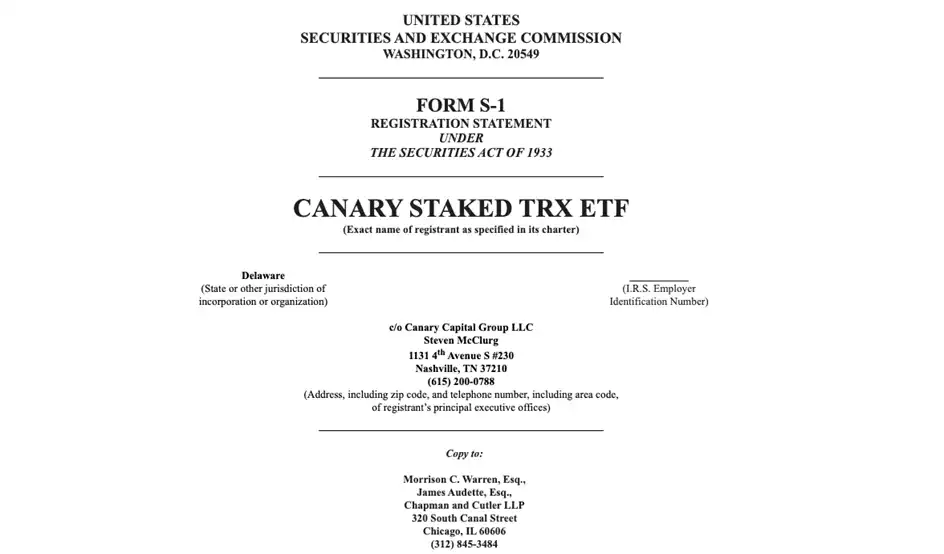
Recently, the U.S. asset management giant Canary Capital officially submitted the S-1 registration statement for a TRX ETF to the U.S. Securities and Exchange Commission (SEC) — the TRX ETF officially submitted the S-1. This is the first time TRON has attempted to enter the U.S. capital market in a "regular army" capacity — a compliant gamble and an image reshaping. Following Justin Sun's pride as a Chinese entrepreneur appearing on the cover of Forbes, TRON is also striving for new heights never reached by a Chinese public chain, bringing a milestone glory to the Chinese Web3.
TRX ETF S-1 Registration Statement: https://www.sec.gov/Archives/edgar/data/2064768/000199937125004423/canary-s1_041825.htm
Looking back at the cryptocurrency market from 2017 to the present, some projects have harvested traffic with meme coins, some projects have become overnight fortunes through regulatory arbitrage, and countless projects have circumvented SEC scrutiny under the guise of "backdoor listings." However, for over a decade, Justin Sun has always adhered to "inheritance, perseverance, and construction," believing that "the market's longevity relies on regulatory compliance and industry faith," which has also established TRON's dominance as the "on-chain dollar" — with the USDT issued on its network occupying over 30% of the stablecoin market share.
But his ambitions clearly extend beyond TRON.
Around this long-standing public chain, Justin Sun has quietly built a complete crypto ecosystem based on compliance, combining a technical foundation, traffic entry points, and value anchoring — the TRON, HTX Exchange Platform, USDD Stablecoin trinity, forming his new strategic "cryptocurrency world triumvirate."
Huobi HTX: Justin Sun Group's "Traffic Engine + Ecosystem Hub"
A public chain is just the underlying foundation, while traffic is the fundamental driver of ecosystem operation. In Justin Sun's ecosystem strategy, Huobi HTX plays a key role in introducing and retaining users, truly driving the entire ecosystem cycle.
How powerful is Huobi HTX?
In the "cooling down" Q1 2025 quarter of the overall crypto market, Huobi HTX delivered an impressive report card.
According to CoinGecko's "2025 Q1 Crypto Industry Report," Huobi HTX is the only platform among the Top 10 exchanges to achieve a growth in spot trading volume. Against the backdrop of an 18.6% decline in the total cryptocurrency market cap, Huobi HTX still managed to achieve a 11.4% increase in spot trading volume month-on-month, while the spot trading volumes of other Top 10 exchanges during the same period generally experienced declines ranging from 1.8% to 34.0%.
Not only in spot trading, Huobi HTX also demonstrated strong growth across its entire product ecosystem:
User and trading volumes have been steadily increasing, especially with outstanding performance in the CIS region and markets such as the Euro stablecoin; contract, yield farming, staking, and other product lines have been continuously optimized, significantly improving user retention through strategies such as fee reductions, enhanced yields, and product diversification.
Meanwhile, Huobi HTX has continued to deepen its ecological partnerships: collaborating with global compliance institutions like Fireblocks to further enhance platform security and compliance, improving the overall trading experience.
Especially worth mentioning is the deep cooperation between Huobi HTX and the TRON Meme ecosystem's Sunpump, which not only bridges the entire process from traffic preheating, initial trading, to subsequent staking and airdrop incentives, establishing a complete "new coin cold start model," but also continuously brings Web3 players to the Huobi HTX platform, converting them into trading users and ecosystem participants.
These achievements reflect Huobi HTX's resilience in a "bear market" environment, indirectly proving that Huobi HTX is leveraging trading as an entry point, aiming for ecosystem development, and becoming the most dynamic part of Justin Sun's ecosystem layout.
USDD: Ambitions of a Stablecoin
A complete ecosystem cannot do without the trump card of a "Stablecoin".
USDD is a decentralized stablecoin project on the TRON blockchain, officially launched on May 5, 2022, and upgraded to USDD 2.0 on January 25 this year. USDD 2.0 ensures its 1:1 peg to the US dollar through multiple mechanisms such as over-collateralization, liquidation and auctions, risk management and real-time monitoring, PSM (Peg Stability Module), decentralized governance, etc., with ample stability and multiple security measures.
As of April 21, the total supply of USDD 2.0 has exceeded 350 million, showing its continued adoption in the global cryptocurrency market. This widespread user adoption indicates that USDD's position in the DeFi community is constantly rising.
In Justin Sun's ecosystem layout, stablecoins carry the grand vision of decentralized finance—breaking through traditional financial barriers and providing a more free, transparent, and efficient cross-border payment and asset management solution through a decentralized payment system.
Breaking the Impossible Triangle, Justin Sun's Dream May Become Reality
In fact, since gracing the cover of Forbes Global Edition, Justin Sun has been continuously referred to in the crypto community as the "counter-trend growth engine" and the unlocker of the blockchain field's "Impossible Triangle"—finding a balance between regulatory compliance, technological innovation, and ecosystem expansion.
Today, he is entering the U.S. capital market with TRX ETF, using Huobi HTX as a traffic entry point, and driving the on-chain economy with a stablecoin, attempting to break the "Impossible Triangle" that plagues all Web3 projects:
● Regulatory Compliance vs Decentralization Narrative
● User Growth vs Market Downturn
● Project Native Token vs Mainstream Financial Acceptance
The S-1 registration application for TRX ETF is a historic step for the Chinese public chain to impact the global financial market and a shining moment for Justin Sun's "Three Musketeers" to leverage the "Impossible Triangle". Once TRX ETF successfully lands, Justin Sun's vision of "enabling 8 billion people worldwide to achieve financial freedom" may no longer be just a slogan but a dream truly coming into reality.
This article is from a submission and does not represent the views of BlockBeats.
You may also like

Scaling Crypto Derivatives: The Digital Asset Infrastructure Behind High-Volume Trading
In the fast-moving digital asset ecosystem, derivatives platforms face an extreme architectural test. High-leverage futures markets demand more than just standard security—they require absolute operational precision, zero-latency matching engines, and ironclad structural scalability, all while navigating intense market volatility.
As global platforms scale to meet these demands, the industry is shifting away from rigid, monolithic setups toward a more agile, "decoupled" infrastructure philosophy.
The Blueprint for High-Volume Copy TradingFor elite global exchanges like WEEX (founded in 2018), this architectural choice becomes critical when scaling high-volume retail features like social copy trading. When thousands of users automatically mirror the real-time strategies of elite traders simultaneously, it triggers sudden, monumental spikes in concurrent transactional volume.
To prevent execution latency or settlement bottlenecks during these peak volatility events, a platform's primary engine must remain entirely dedicated to risk management, copy-trade synchronization, and order matching.
The Architectural Rule: New-generation platforms must separate front-end user execution engines from heavy backend infrastructural overhead to eliminate operational friction.
By separating these layers, platforms can maintain complete sovereignty over their trading environments and user experiences while strategically aligning with institutional-grade infrastructure ecosystems. This strategic framework allows modern exchanges to leverage advanced Digital Asset Custody infrastructure such as Cobo’s behind the scenes, ensuring that backend wallet management scales elastically alongside trading spikes.
Capitalizing on Market Momentum and 400× LeverageIn a derivatives arena where platforms offer up to 400× leverage on perpetual contracts, capital efficiency and market agility are core business metrics. To capture market momentum, an exchange needs the ability to rapidly expand its asset offerings, supporting everything from legacy crypto assets to sudden, trending altcoins across a massive library of trading pairs.
Adopting a flexible, scalable Wallet-as-a-Service (WaaS) solution such as Cobo’s could completely rewrite the development timeline for high-growth exchanges. Instead of spending months of engineering capital building out custom backend wallet architectures for every new blockchain network, platforms can deploy localized infrastructure in days.
This agility allows platforms to instantly scale their listings to over a thousand trading pairs without compromising security or delaying time-to-market. It mirrors the exact operational advantages seen during high-velocity market events, similar to how advanced wallet infrastructure empowers platforms during sudden asset surges; allowing exchanges to pass that speed and liquidity directly to their global user base.
A Mature Foundation for GrowthThe synergy between trusted infrastructure ecosystems and global trading platforms represents the natural evolution of a maturing crypto market. As WEEX continues to scale its global spot and derivatives offerings for over 6 million users, adopting robust backend paradigms proves that platforms no longer have to compromise between cutting-edge trading velocity and uncompromised structural security.

Morning Report | BitMine increased its holdings by 126,971 ETH last week; trader Eugene announced his exit from the crypto market

Wang Chuan: How can one not feel anxious after the neighbor Old Wang made thirty times profit by investing in storage stocks? (Seven) - A quarter-century cycle

Get Paid to Onboard? Try WEEX’s New Homepage with Rewards for Registration, Deposit & Trade

WEEX Custom Layout: Build Your Perfect Trading Workspace in Seconds

See “Buy Walls” & “Sell Walls” Instantly: WEEX Launches the Depth Chart for Smarter Trades

What Is Quick Trade on WEEX? 2 Ways WEEX Ends Chart-Panel Jumping

Morning News | Five major virtual asset platforms in South Korea have experienced 57 incidents of hacking and system failures in six years; Grayscale submits registration application for Canton ETF

Should we escape the peak? The principle of the tail-end market in the stock market

RootData: May 2026 Cryptocurrency Exchange Transparency Research Report

Founder of Baixing.com: My Experience with Claude Code in Fourteen Points

Yang Ge Gary: Agent Economics and AI Microeconomics
When reasoning becomes a scarce resource, who captures its value?

Jensen Huang dramatically "rescues" the South Korean stock market

Stablecoins vs Deposit Tokens: On the surface, they seem like opposing sides, but in reality, they are interconnected

Bitcoin Crash to $50,000 or Bear Trap Before $100,000? Deep Dive for WEEX Traders
How Could the SpaceX IPO Affect Bitcoin, Altcoins season, and Crypto Liquidity?

The ambitions of Kalshi, MTS, and a16z
Scaling Crypto Derivatives: The Digital Asset Infrastructure Behind High-Volume Trading
In the fast-moving digital asset ecosystem, derivatives platforms face an extreme architectural test. High-leverage futures markets demand more than just standard security—they require absolute operational precision, zero-latency matching engines, and ironclad structural scalability, all while navigating intense market volatility.
As global platforms scale to meet these demands, the industry is shifting away from rigid, monolithic setups toward a more agile, "decoupled" infrastructure philosophy.
The Blueprint for High-Volume Copy TradingFor elite global exchanges like WEEX (founded in 2018), this architectural choice becomes critical when scaling high-volume retail features like social copy trading. When thousands of users automatically mirror the real-time strategies of elite traders simultaneously, it triggers sudden, monumental spikes in concurrent transactional volume.
To prevent execution latency or settlement bottlenecks during these peak volatility events, a platform's primary engine must remain entirely dedicated to risk management, copy-trade synchronization, and order matching.
The Architectural Rule: New-generation platforms must separate front-end user execution engines from heavy backend infrastructural overhead to eliminate operational friction.
By separating these layers, platforms can maintain complete sovereignty over their trading environments and user experiences while strategically aligning with institutional-grade infrastructure ecosystems. This strategic framework allows modern exchanges to leverage advanced Digital Asset Custody infrastructure such as Cobo’s behind the scenes, ensuring that backend wallet management scales elastically alongside trading spikes.
Capitalizing on Market Momentum and 400× LeverageIn a derivatives arena where platforms offer up to 400× leverage on perpetual contracts, capital efficiency and market agility are core business metrics. To capture market momentum, an exchange needs the ability to rapidly expand its asset offerings, supporting everything from legacy crypto assets to sudden, trending altcoins across a massive library of trading pairs.
Adopting a flexible, scalable Wallet-as-a-Service (WaaS) solution such as Cobo’s could completely rewrite the development timeline for high-growth exchanges. Instead of spending months of engineering capital building out custom backend wallet architectures for every new blockchain network, platforms can deploy localized infrastructure in days.
This agility allows platforms to instantly scale their listings to over a thousand trading pairs without compromising security or delaying time-to-market. It mirrors the exact operational advantages seen during high-velocity market events, similar to how advanced wallet infrastructure empowers platforms during sudden asset surges; allowing exchanges to pass that speed and liquidity directly to their global user base.
A Mature Foundation for GrowthThe synergy between trusted infrastructure ecosystems and global trading platforms represents the natural evolution of a maturing crypto market. As WEEX continues to scale its global spot and derivatives offerings for over 6 million users, adopting robust backend paradigms proves that platforms no longer have to compromise between cutting-edge trading velocity and uncompromised structural security.
Morning Report | BitMine increased its holdings by 126,971 ETH last week; trader Eugene announced his exit from the crypto market
Wang Chuan: How can one not feel anxious after the neighbor Old Wang made thirty times profit by investing in storage stocks? (Seven) - A quarter-century cycle
Get Paid to Onboard? Try WEEX’s New Homepage with Rewards for Registration, Deposit & Trade
WEEX Custom Layout: Build Your Perfect Trading Workspace in Seconds
See “Buy Walls” & “Sell Walls” Instantly: WEEX Launches the Depth Chart for Smarter Trades


