
ZORA Airdrop Disaster: Early Users "HODL" for Four Years, Average Per Person Less Than $40


Original Title: "Zora Airdrop Faces On-Chain Backlash: Early Users Feel Betrayed, Average Airdrop Only $37"
Original Author: Nancy, PANews
After years of anticipation, the long-awaited Zora airdrop finally took place. However, community members who had eagerly awaited this moment were left disappointed. Upon opening their wallets, all they found was a reward that couldn't even cover the gas fee, let alone a token with no utility. The community's emotions reached a boiling point, and the on-chain reputation protocol Ethos unexpectedly became the outlet for users to express their dissatisfaction. Zora's "car crash scene" was permanently recorded on the blockchain, leaving a mark of shattered trust.
Airdrop Backfires on Early Users, Token Distribution Accused of Abandoning the Community
Last month, Zora announced the upcoming launch of its native token, ZORA, creating high expectations within the community that had been waiting for years. In the days leading up to the airdrop, Base, the official platform, issued a series of tweets to hype up Zora, attracting a lot of attention with various memes and skyrocketing data metrics.
However, this airdrop turned out to be a massive disappointment. On April 23, Zora opened the airdrop claiming to distribute 1 billion ZORA tokens to 2,415,024 addresses. Most of the airdropped tokens were based on the first snapshot distribution (from January 1, 2020, 8:00, to March 3, 2025, 22:00), with a smaller portion based on the second snapshot distribution (from March 3, 2025, 22:00, to April 20, 2025, 8:00), which also covered activity on Zora's latest Coins protocol. The specific distribution amounts were calculated based on user activity on Zora and their overall participation in the current protocol and its older versions, including but not limited to minting, trading, and referrals.
Simultaneously, the ZORA token was listed on Binance Alpha, with eligible users receiving a 4276 ZORA token airdrop. However, this airdrop result angered many long-time participants in the Zora ecosystem, as they received only a small amount of tokens, barely enough to cover the gas fee.
Recent speculators and Binance Alpha users easily walked away with a large number of tokens. This severe imbalance in distribution not only sparked widespread anger in the community but was also seen as a betrayal of early supporters. What exacerbated the community's dissatisfaction was that the Zora airdrop snapshot was divided into two parts, yet the specific distribution criteria were never made public, leading to a lack of transparency throughout the process.
Moreover, Zora has also faced strong community scrutiny due to its highly concentrated and opaque distribution ratio. According to Zora's disclosed tokenomics, the community airdrop accounts for only 10%, while the team, treasury, and strategic contributors allocation stands at a high 65%, with a mere 6-month lock-up period before unlocking commences, and the specific unlocking schedule is similarly not clearly stated.
Furthermore, the Zora team has officially stated that the ZORA token is merely a "just for fun" MEME coin, carrying no technical or governance functions, primarily used for community rewards and ecosystem incentives. This positioning has sparked a series of questions from the community: Since the token does not have any substantial utility, why does the team still need to occupy such a high percentage? And on what basis does the community trust that ZORA holds long-term value?
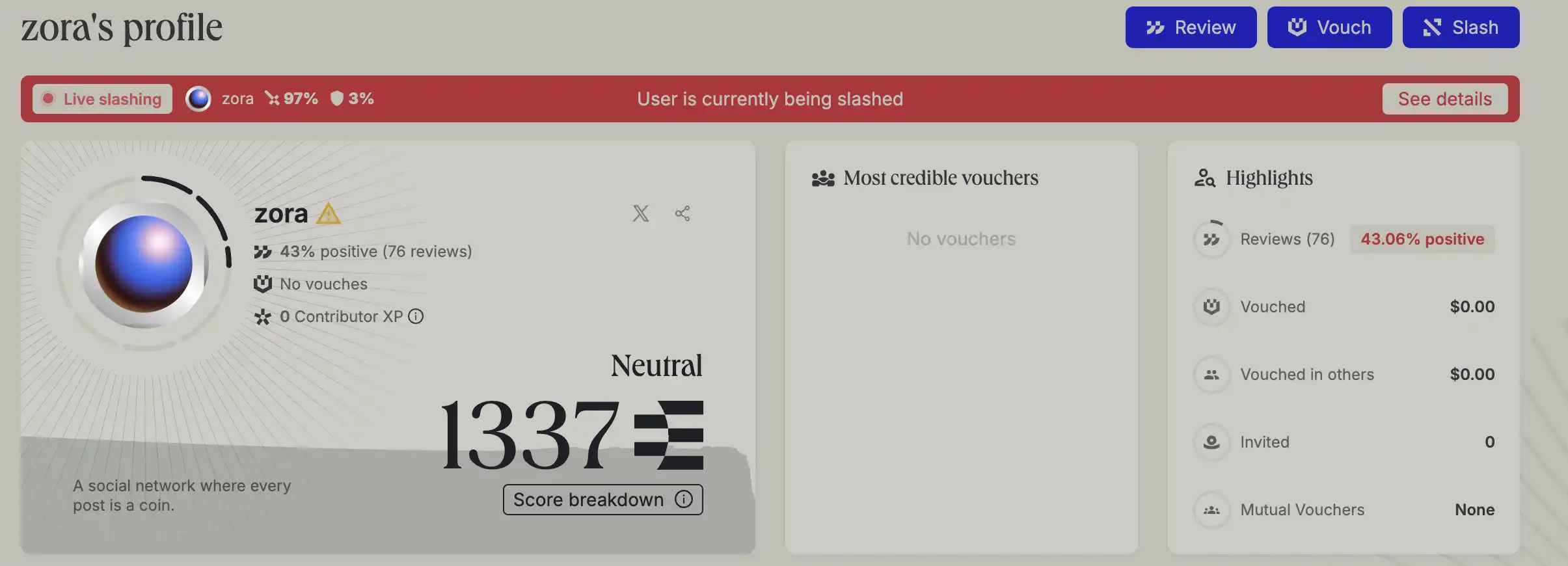
Amidst multiple disappointments, Ethos's negative review feature has been seen as an outlet for emotional value expression, with community users leaving "downvotes" en masse, leading to a rapid decline in Zora's credibility score. Many users have been outspoken, stating, "On-chain records are immutable; malicious projects must be recorded in history."
Airdrop Progress: Over Halfway with User Claim Rate Below 20%, Average User Receives Only $37
In terms of price performance, Binance data shows that after ZORA was listed, it briefly surged to $0.0466, only to plummet to a low of $0.0172 the next day, a nearly 63% decline, cooling off the market hype rapidly.
According to Dune data, as of the time of writing, over 514 million tokens have been successfully claimed by users in the ZORA airdrop. Among them, the top 50 addresses have collectively claimed more than 190 million tokens, with an average of about 3.931 million tokens per address. Based on the current price (approximately $0.0235), this is worth around $9,200, accounting for 36.9% of the total claimed amount. This indicates a significant concentration of distribution toward the top wallet addresses.
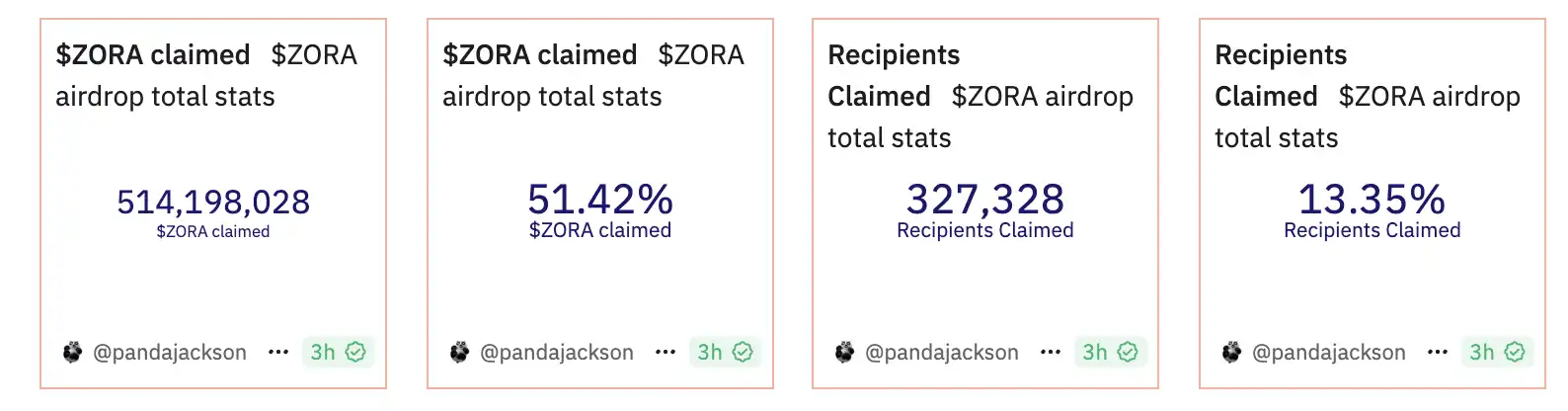
At the same time, in terms of the number of participating users, there are already over 320,000 users participating in the claim, but the average user has only claimed 1,571.1 ZORA, equivalent to about $37. This stark contrast highlights the extreme imbalance in the distribution structure—large holders receive a substantial airdrop, while regular users receive a very limited allocation.
In terms of claim progress, approximately 51.42% of the total token supply has been claimed, but only 13.35% of eligible users have actually completed the claim process, further indicating that the proportion of users actively claiming is very low, with most users tending to forego claiming.
Significant Drop in User Engagement as Controversy Arises over Transition to On-Chain Social
Founded in 2020, Zora was originally positioned as an NFT marketplace protocol. Public data shows that the project has raised at least $52 million in funding, with investment firms including Coinbase Ventures, Paradigm, Haun Ventures, among others, with the latest funding round valuing the project at $6 billion. However, as the NFT market cooled off and competition intensified, Zora gradually evolved to focus on on-chain social and the creator economy ecosystem, including the introduction of the "Coins" feature, which automatically mints each piece of social content (such as images, videos, text) into an ERC-20 token, and the launch of its own Layer2 network, Zora Network.
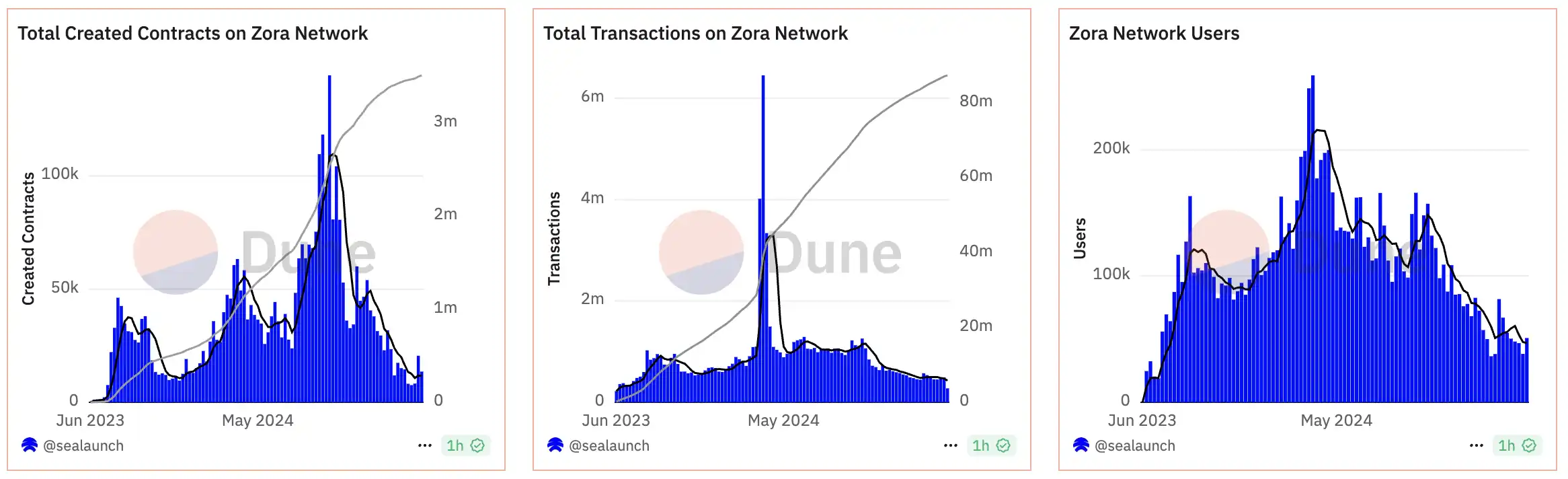
Despite continuously exploring new narrative directions, the overall ecosystem activity of Zora has significantly declined. According to Dune data, as of April 24, the total smart contracts created on the Zora network have exceeded 3.51 million, but looking at the daily contract creation numbers, the data has dropped from the early peak of 144,000 transactions to around 13,000 transactions, which is less than ten percent of the peak; similarly, the cumulative transaction volume on the Zora network has surpassed 87.4 million transactions, however, the daily transaction volume has dropped from a historical peak of 3.338 million transactions to the current approximately 428,000 transactions; although the total number of active addresses has reached 470,000, comparing to the daily active users of about 259,000 at the peak last year, it has now decreased to 50,900, showing a decrease in user engagement.
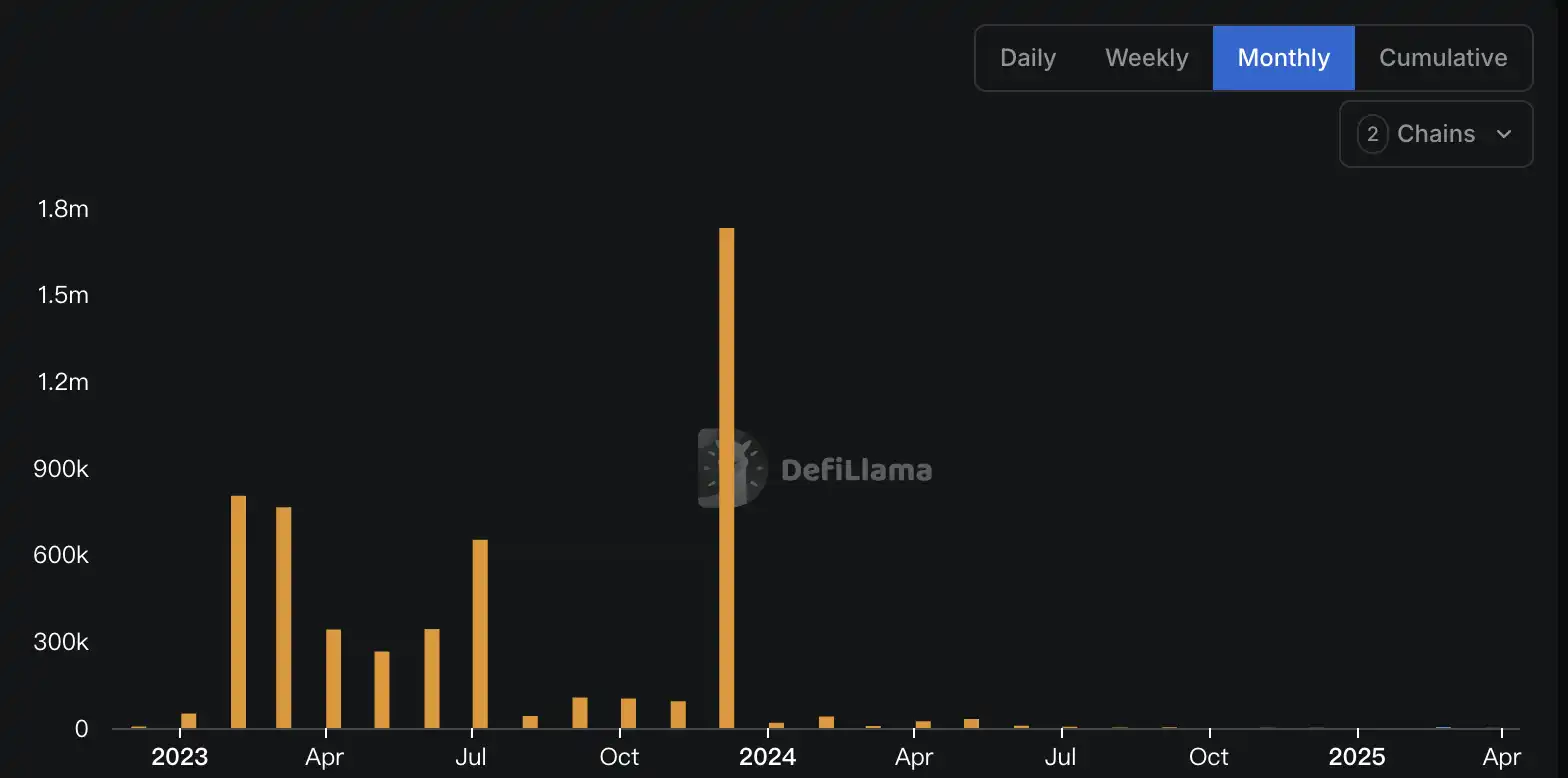
In terms of revenue, according to DeFiLlama and Dune data, Zora's accumulated revenue is only $5.4 million, and Zora Network's profit is only 527.74 ETH. It is also believed by the community that this is far from the market expectations corresponding to its $6 billion valuation.
Furthermore, although Zora claims to have brought tens of millions of dollars in revenue to creators, its on-chain experimental and tokenized narrative has sparked controversy. For example, Jesse Pollak, the head of Base Protocol, recently praised the record-breaking active users of Zora Coins, but ZachXBT criticized these tokens as "viruses," with a market cap of less than $5 million. In response, Jesse admitted that most content is nearly worthless, with a small amount of content having huge value, but ZachXBT questioned why creators would issue a large number of tokens to dilute their brand. Jesse rebutted that on-chain creation does not dilute the brand, good content will naturally spread, and the market and algorithms determine its value.
Overall, Zora is attempting to reshape itself through on-chain social interactions and tokenized storytelling, but its overinflated valuation and increasingly cooling ecosystem have long planted the seeds of a trust crisis. This lackluster airdrop may very well be the final straw that breaks the community's confidence.
You may also like

Bitcoin Trading Guide 2026: Strategies for Experienced Traders

What Is XAUT and PAXG? Why Tokenized Gold Is Booming in 2026

Cryptocurrency CEXs are flocking to sell US stocks, and traditional brokerages are facing an "uninvited guest."

Will the SpaceX IPO Hurt Bitcoin? Here's What Traders Are Watching
Foreign selling in the South Korean stock market accelerates, with cumulative net sales reportedly reaching $75 billion this year
On June 9, The Kobeissi Letter, citing Goldman Sachs data, reported that global investors are selling South Korean stocks at an unusually rapid pace. In the latest trading session, foreign investors sold about $801 million worth of Kospi constituent stocks again; total foreign outflows last week reached about $10 billion, and the market has been in net foreign selling on nearly every trading day over the past month. According to the data cited in the report, foreign investors have sold about $75 billion worth of South Korean stocks so far this year. Meanwhile, South Korean retail and institutional investors together recorded roughly $69 billion in net buying over the same period, suggesting that the market’s main buying support has come from domestic capital rather than returning overseas funds. The information currently disclosed still mainly comes from The Kobeissi Letter’s retelling and Goldman Sachs data summaries, while public details on the statistical period and the specific definition of “selling” remain relatively limited.

Fortune Warns of Strategy’s Financing Structure Risks as Bitcoin Premium Narrows
Fortune warned that Strategy’s Bitcoin treasury model faces growing financing risks as MSTR’s net asset premium narrows and preferred stock dividend pressure increases.

Ferrari Challenge Le Mans: Carl Moon to Dominate in WEEX Livery

Sahara AI Responds to SAHARA’s Sharp Drop: No Contract or Product Security Issues Found, Internal Investigation Underway
Sahara AI responded to SAHARA’s 60% price drop, saying no token contract or product security issues have been found and an internal investigation is underway.

WEEX Deposit/Withdrawal Dynamic Island: Your Asset Status, Always in Sight

Scaling Crypto Derivatives: The Digital Asset Infrastructure Behind High-Volume Trading
In the fast-moving digital asset ecosystem, derivatives platforms face an extreme architectural test. High-leverage futures markets demand more than just standard security—they require absolute operational precision, zero-latency matching engines, and ironclad structural scalability, all while navigating intense market volatility.
As global platforms scale to meet these demands, the industry is shifting away from rigid, monolithic setups toward a more agile, "decoupled" infrastructure philosophy.
The Blueprint for High-Volume Copy TradingFor elite global exchanges like WEEX (founded in 2018), this architectural choice becomes critical when scaling high-volume retail features like social copy trading. When thousands of users automatically mirror the real-time strategies of elite traders simultaneously, it triggers sudden, monumental spikes in concurrent transactional volume.
To prevent execution latency or settlement bottlenecks during these peak volatility events, a platform's primary engine must remain entirely dedicated to risk management, copy-trade synchronization, and order matching.
The Architectural Rule: New-generation platforms must separate front-end user execution engines from heavy backend infrastructural overhead to eliminate operational friction.
By separating these layers, platforms can maintain complete sovereignty over their trading environments and user experiences while strategically aligning with institutional-grade infrastructure ecosystems. This strategic framework allows modern exchanges to leverage advanced Digital Asset Custody infrastructure such as Cobo’s behind the scenes, ensuring that backend wallet management scales elastically alongside trading spikes.
Capitalizing on Market Momentum and 400× LeverageIn a derivatives arena where platforms offer up to 400× leverage on perpetual contracts, capital efficiency and market agility are core business metrics. To capture market momentum, an exchange needs the ability to rapidly expand its asset offerings, supporting everything from legacy crypto assets to sudden, trending altcoins across a massive library of trading pairs.
Adopting a flexible, scalable Wallet-as-a-Service (WaaS) solution such as Cobo’s could completely rewrite the development timeline for high-growth exchanges. Instead of spending months of engineering capital building out custom backend wallet architectures for every new blockchain network, platforms can deploy localized infrastructure in days.
This agility allows platforms to instantly scale their listings to over a thousand trading pairs without compromising security or delaying time-to-market. It mirrors the exact operational advantages seen during high-velocity market events, similar to how advanced wallet infrastructure empowers platforms during sudden asset surges; allowing exchanges to pass that speed and liquidity directly to their global user base.
A Mature Foundation for GrowthThe synergy between trusted infrastructure ecosystems and global trading platforms represents the natural evolution of a maturing crypto market. As WEEX continues to scale its global spot and derivatives offerings for over 6 million users, adopting robust backend paradigms proves that platforms no longer have to compromise between cutting-edge trading velocity and uncompromised structural security.

Morning Report | BitMine increased its holdings by 126,971 ETH last week; trader Eugene announced his exit from the crypto market

Wang Chuan: How can one not feel anxious after the neighbor Old Wang made thirty times profit by investing in storage stocks? (Seven) - A quarter-century cycle

Get Paid to Onboard? Try WEEX’s New Homepage with Rewards for Registration, Deposit & Trade

WEEX Custom Layout: Build Your Perfect Trading Workspace in Seconds

See “Buy Walls” & “Sell Walls” Instantly: WEEX Launches the Depth Chart for Smarter Trades

What Is Quick Trade on WEEX? 2 Ways WEEX Ends Chart-Panel Jumping
Morning News | Five major virtual asset platforms in South Korea have experienced 57 incidents of hacking and system failures in six years; Grayscale submits registration application for Canton ETF
Should we escape the peak? The principle of the tail-end market in the stock market
Bitcoin Trading Guide 2026: Strategies for Experienced Traders
What Is XAUT and PAXG? Why Tokenized Gold Is Booming in 2026
Cryptocurrency CEXs are flocking to sell US stocks, and traditional brokerages are facing an "uninvited guest."
Will the SpaceX IPO Hurt Bitcoin? Here's What Traders Are Watching
Foreign selling in the South Korean stock market accelerates, with cumulative net sales reportedly reaching $75 billion this year
On June 9, The Kobeissi Letter, citing Goldman Sachs data, reported that global investors are selling South Korean stocks at an unusually rapid pace. In the latest trading session, foreign investors sold about $801 million worth of Kospi constituent stocks again; total foreign outflows last week reached about $10 billion, and the market has been in net foreign selling on nearly every trading day over the past month. According to the data cited in the report, foreign investors have sold about $75 billion worth of South Korean stocks so far this year. Meanwhile, South Korean retail and institutional investors together recorded roughly $69 billion in net buying over the same period, suggesting that the market’s main buying support has come from domestic capital rather than returning overseas funds. The information currently disclosed still mainly comes from The Kobeissi Letter’s retelling and Goldman Sachs data summaries, while public details on the statistical period and the specific definition of “selling” remain relatively limited.
Fortune Warns of Strategy’s Financing Structure Risks as Bitcoin Premium Narrows
Fortune warned that Strategy’s Bitcoin treasury model faces growing financing risks as MSTR’s net asset premium narrows and preferred stock dividend pressure increases.


